
Fairhope's Median House Was Built in 1997. Fifteen Hundred of Them Weren't.
Census counts 279 Fairhope housing units built in 1939 or earlier and 1,517 built before 1970 — about one in seven. The median of 1997 hides them, and they are the houses with cast iron drain lines under them.
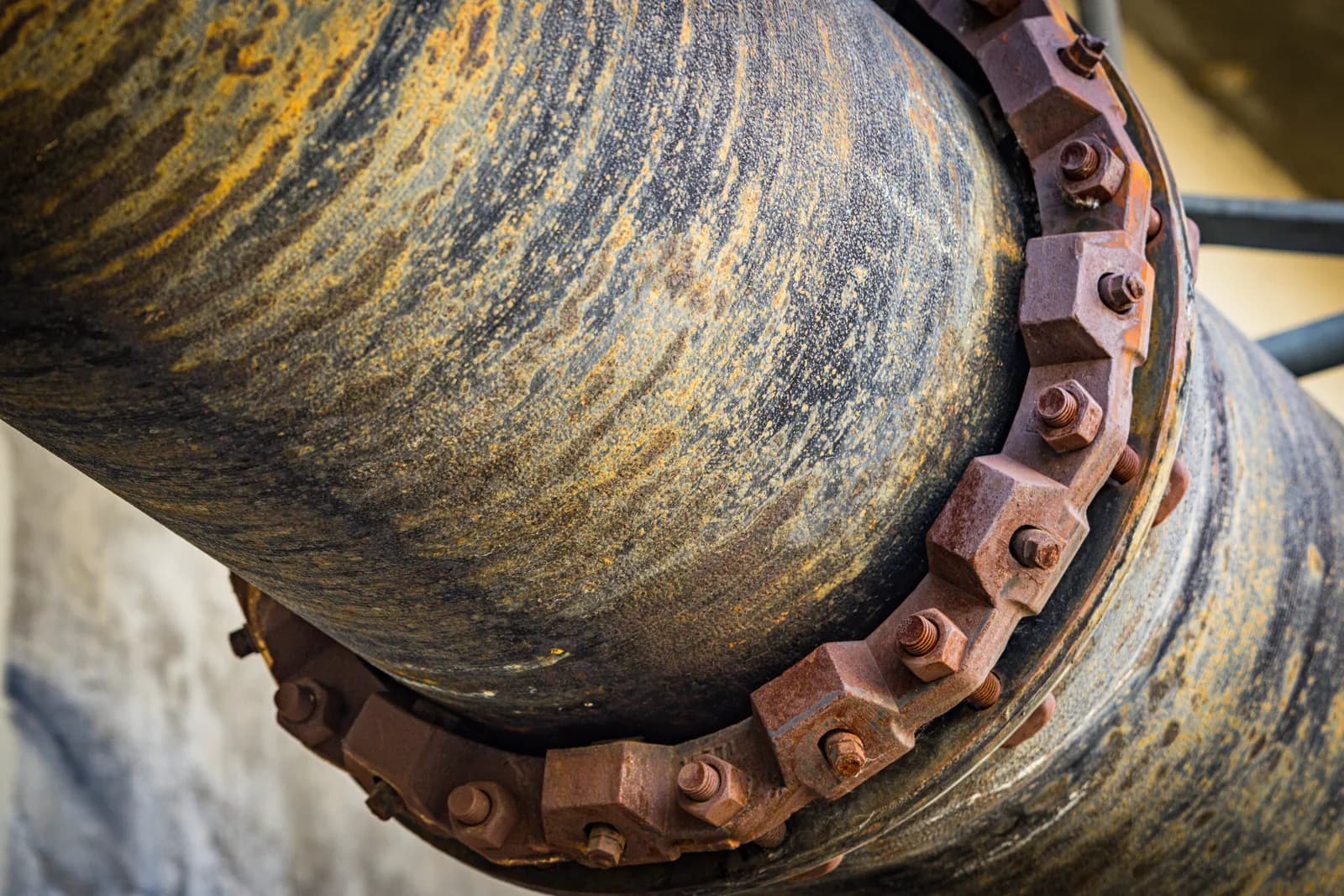
Fairhope's median year built is 1997, and that figure gets quoted around here as though it described the town. It does not. Census counts 10,360 housing units in the city, and 1,517 of them — about one in seven — were built before 1970, including 279 dating from 1939 or earlier. A median is the middle of a distribution, and this distribution has two humps. The older one is where the cast iron is.
The numbers the median hides
Here is the whole distribution, from the ACS 2023 five-year estimates, for Fairhope city:
| Built | Units | Drain material of the era |
|---|---|---|
| 2020 or later | 241 | Plastic |
| 2010–2019 | 2,088 | Plastic |
| 2000–2009 | 2,252 | Plastic |
| 1990–1999 | 2,075 | Plastic |
| 1980–1989 | 1,145 | Plastic |
| 1970–1979 | 1,042 | Transition — either, sometimes both |
| 1960–1969 | 693 | Cast iron |
| 1950–1959 | 415 | Cast iron |
| 1940–1949 | 130 | Cast iron |
| 1939 or earlier | 279 | Cast iron |
| Total | 10,360 |
Three-quarters of the town — 7,801 of the 10,360 units — was built from 1980 onward. That is the hump the median sits on, and those houses are a plastic-drain story with nothing much to say.
The 1,042 units from the 1970s are the transition, and they can be either. The 1,517 below that line are a different building. Cast iron was the standard residential drain-waste-vent material through roughly the 1960s before plastic displaced it, so a house from the 824 units built before 1960 is very likely to have cast iron somewhere under it, and a house from the 279 built in 1939 or earlier has had eighty-odd years of water running along the bottom of that pipe.
Those 824 pre-1960 units are not scattered evenly. They cluster where the town started, in the older blocks between downtown and the Pier and out through the Fruit and Nut District — a neighbourhood whose name is itself a record of when and how it was laid out. What no dataset will do is tell you which parcels. Era narrows the field; only looking settles it.
What cast iron does, in one paragraph
It rusts from the inside, where the water is, and the rust builds inward as scale that narrows the bore. Then the iron corrodes away from the graphite structure that was mixed through it, so the pipe keeps its shape and loses its strength. Then the wear concentrates along the bottom of the bore, where the water actually runs, and cuts a channel. Then the channel goes through.
Four stages, each of which presents as a different household complaint, and homeowners routinely pay to solve the first one three separate times. The full sequence and what each stage looks like from inside the house is set out in how cast iron fails, and in what order. There is no point repeating it here. What is worth adding is the part that is specific to this town.
The bluff is doing you a favour, and not evenly
Fairhope's ground elevation at the city coordinate is about 121 feet, above the 100-foot median of the 22 communities we cover, and the ground falls away from there toward the water.
Fall matters to a drain line more than almost anything else. Wastewater carries solids only as long as it is moving, and a line with genuine gravity behind it scours its own invert, which is exactly the surface that channels first. A nearly flat run does not, so it accumulates, and accumulation on a rough scaled surface is how a narrowed line becomes a blocked one.
The consequence for Fairhope is a gradient rather than a single answer. A house up on the ridge along Greeno Road and a house down on the bluff side toward Mobile Bay are the same age and are not on the same hydraulic footing. Two houses built the same year by the same builder can be at stage one and stage three, and the difference is not maintenance — it is topography.
That reasoning stops at the property line, and deliberately. Nothing here says anything about how the municipal wastewater side of this city is arranged, because the public records behind this site are EPA drinking-water records and they contain no wastewater information at all. What is being described is the fall on your own line, between your house and wherever your responsibility ends — and where that boundary sits is a question for your utility and your plat, not for me.
How do you find out what era your own house is from?
Three sources, in increasing order of usefulness.
The paperwork. Your deed, your parcel's assessment record and any permit history all carry a construction year. Take it as a starting point rather than a verdict, because additions carry their own dates and the drain under a 1958 kitchen may have been replaced in 1994 when the kitchen was.
The pipe itself. Cast iron is heavy, holds a magnet, and gives a dull ring rather than a sharp one. Look at the joints. Older hub-and-spigot cast iron is joined by a bell-shaped hub packed and sealed; later cast iron uses a rubber sleeve and a stainless band. Plastic is obvious and light. If you can see the drain stack in a crawlspace, a garage, or where it leaves the building, you have your answer in two minutes.
A camera, once. Not on a schedule — once, to establish what you own. Find the cleanout first and confirm it is accessible; in houses of this vintage it is often under thirty years of landscaping. Then a camera inspection produces a map: which lengths are scaled, which are channelled, which are sound. That map is what turns a replacement into a repair, and it is the single highest-value thing you can do to an old house's drains.
What to do with the answer
If the line is at stage one and the house is otherwise fine, you are managing a narrowing bore, and the question becomes which tool. Scale and a blockage respond to completely different things, and putting the wrong one down a compromised line is how a drain problem becomes a dig — the comparison is worked through in hydro jetting versus snaking, and routine care is ordinary drain cleaning. The Fairhope drain page covers what that looks like at an address here.
If the line is channelled or perforated, the affected section is coming out, and that is sewer line repair work — the Fairhope page for the local version, and the sewer line repair cost guide for what the range actually depends on.
And if the drains are telling you their age, check the other side of the wall before you close it. A house of this era very often has galvanized supply pipe installed by the same crew in the same year, and the public record now has something useful to say about it — the service line inventory is a free first step, and what the drinking-water record does and does not establish here sets out the limits of it. A recurring slow drain in a house this old is worth a look rather than another cable.
(251) 423-7654, any hour. Brandon Byrd, Alabama Master Plumber MP-4462, working out of Morphy Avenue.
Sources. Housing units by year built — 10,360 total; 279 built 1939 or earlier; 130 in 1940–1949; 415 in 1950–1959; 693 in 1960–1969; 1,042 in 1970–1979; 1,145 in 1980–1989; 2,075 in 1990–1999; 2,252 in 2000–2009; 2,088 in 2010–2019; 241 in 2020 or later — from US Census Bureau, American Community Survey 2023 5-year estimates, table B25034, for Fairhope city, Alabama (api.census.gov/data/2023/acs/acs5). Median year built, median home value and owner-occupancy rate from the same ACS 2023 5-year release, place level. Ground elevation from the USGS 3DEP point query service (epqs.nationalmap.gov) at the city coordinate. ASTM A74 (hub-and-spigot cast iron soil pipe) and ASTM A888 with CISPI 301 (hubless) for the joint types described.