
No Hot Water? We'll Get It Back.
Cold showers, rusty water, a puddle under the tank, or a unit that just quit — we repair, replace, and install water heaters across Baldwin County, tank and tankless, often the same day. Licensed Alabama Master Plumber — MP-4462. Upfront pricing, and a 2-year warranty on our repair work.
- 01Diagnose
- 02Price
- 03Repair
Get a Free Estimate
Name and phone is all we need to call you back. Takes ~20 seconds.
37+ five-star reviews · Fast response · Licensed Master Plumber MP-4462
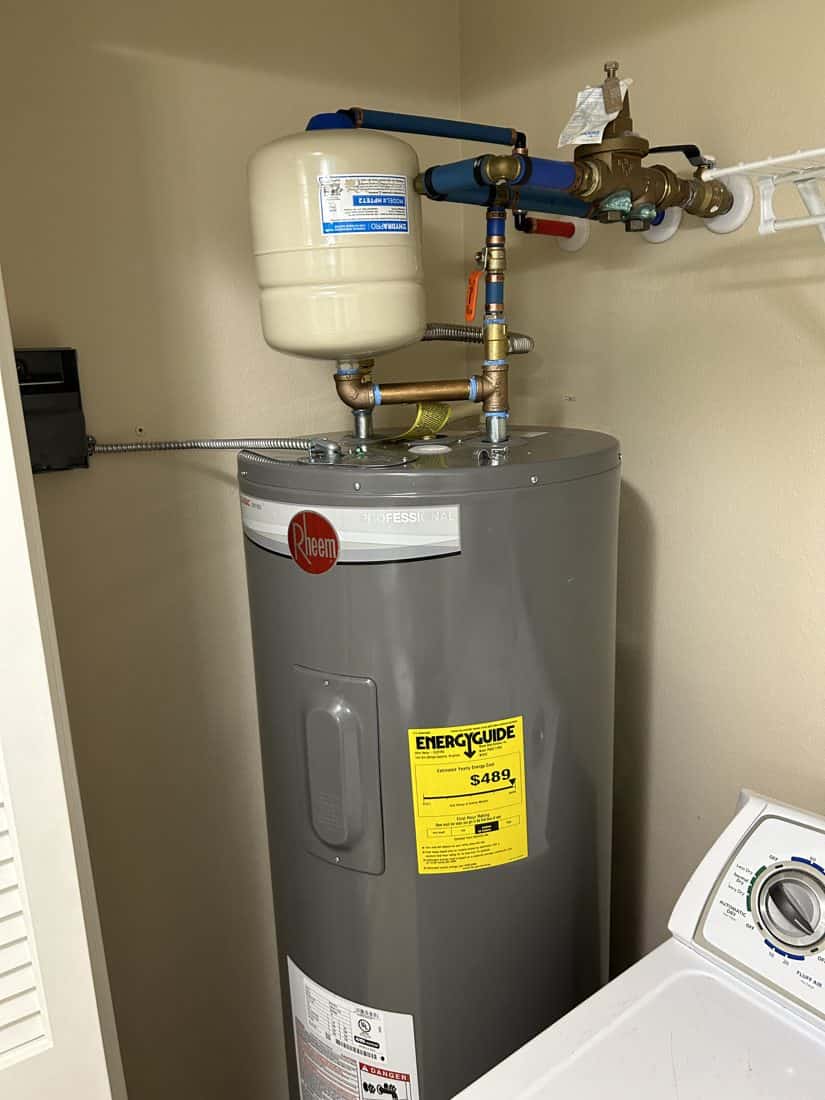
A water heater usually fails at the worst time — the morning it's rusty, the day there's a puddle under it, the weekend it stops heating. Streamlined Plumbing repairs and replaces both traditional tank and tankless water heaters across Baldwin County. We'll tell you honestly whether yours is worth repairing or whether replacement is the smarter money, and we can often have hot water back the same day.
Thinking about ditching the tank for good? We install and service tankless water heaters for endless hot water and lower standby losses.
Repair, Replace, or Upgrade.
Tank or tankless, gas-fired or electric, we service what you have and install what you need. Common calls across the county:
- No hot water or water that never gets hot enough
- Rusty, brown, or metallic-smelling hot water
- Water pooling or leaking around the base of the tank
- Popping, rumbling, or banging from sediment buildup
- Pilot or heating element that won't stay lit or on
- Tanks past their service life you want to replace before they fail
- New tankless installs and tank-to-tankless conversions
- Failed T&P relief valves, thermostats, and anode rods
What water heater repair & replacement actually turns on here.
Start with the load the appliance is under, because in Baldwin County that load is lopsided in a way worth knowing about. Twenty-one of the 22 communities on this page have usable 2025 climate readings, and in every single one of them the year logged more cooling degree days than heating degree days. Loxley's 2025 pair was 2,613 cooling against 1,530 heating; Gulf Shores' was 2,902 against 1,235. Put plainly, this county spends the bulk of the calendar removing heat from buildings. A storage water heater does the opposite around the clock: it holds forty to eighty gallons at temperature and leaks warmth into whatever room it stands in. Where that room is inside the conditioned envelope — a hall closet, an interior utility room — you are paying twice for most of the year, once to make the heat and again to take it back out. That arithmetic is why closet placement, insulation on the first few feet of pipe leaving the tank, and an honest look at what a tank costs to keep hot are worth raising here rather than treated as fine print.
Now the water itself, where the county record points somewhere unexpected. Almost every maintenance article written about tank heaters leads on sediment: mineral drops out of solution, settles on the bottom, the burner or element works through a layer of grit, the tank rumbles. That is an argument from mineral-rich supply, and the United States Geological Survey record for Baldwin County wells describes the opposite end of the scale. Across 177 hardness measurements the middle result is 12.0 milligrams per litre as calcium carbonate — 0.70 grains per gallon — and 87% of results sit under the 60 mg/L mark the USGS uses for soft water. The companion series of 248 pH measurements has a middle result of 5.90, with 79% below neutral and two in three below 6.5, the bottom of the EPA secondary range. Very little dissolved mineral, and a reading under neutral. Flushing a tank is still worth doing and we still do it — but if you have been told sediment is the main thing standing between you and a long-lived heater, that advice was written for a different aquifer.
Which moves the interesting question onto a component almost nobody looks at. A steel tank is protected by a sacrificial anode: a rod threaded into the top whose entire purpose is to give itself up so the tank does not. It is consumable by design, it is invisible from outside, and in a decade of service most heaters never have it pulled and read. On a county whose raw source water sits below neutral, that is the part of a tank heater the maintenance conversation ought to be about, and it is the reading we take when we are already at the unit for something else. The same logic reaches the relief valve and the expansion tank, both of which are cheap, both of which fail quietly, and neither of which announces itself until the day it matters. None of this is a claim about how fast anything wears at your address — no dataset says that. It is a claim about which parts are worth the two minutes it takes to check.
One more split decides which evidence applies to you. These 177 hardness and 248 pH readings come from wells: raw groundwater, sampled at the ground, not water out of anyone's tap. Twelve of the 22 communities here carry a registered, active community water system in the EPA record — fifteen registrations across those twelve. A registered utility owes corrosion control under the federal Lead and Copper Rule, so water reaching those tanks has been adjusted before it arrives and the well series is aquifer background rather than a description of the supply. The remaining ten communities have no registered system in the record, so nothing stands between the ground and the tank. And the distribution has a long tail worth respecting: that hardness series runs from 0.0 all the way to 990.0 mg/L, with 13 results in every hundred above the soft threshold. A county middle is not a verdict on any individual well, and we will not treat it as one. Test the supply, then decide. Brandon Byrd carries Alabama Master Plumber licence MP-4462, the repair work carries a two-year warranty, and the phone is answered at any hour on (251) 423-7654. Gas-fired units are common here and we do not perform gas work — the gas connection and venting stay with a qualified gas fitter.
How this differs town to town
What changes from one Baldwin County community to the next on a water heater is mostly the duty cycle and the supply. The 2025 climate record gives the first of those as a pair of degree-day totals — how much of the year the buildings were being cooled versus heated — and the EPA record gives the second as whether a registered utility stands between the aquifer and the tank. Fort Morgan's climate cell is water-dominated and unusable, so it carries no weather figures at all; Montrose shares a grid cell with Fairhope and Rosinton shares one with Robertsdale, so those two carry the housing and supply picture instead of a duplicate reading.
- Gulf Shores
The 2025 readings here are 2,902 cooling degree days against 1,235 heating, so an interior-closet tank spends the great majority of the calendar shedding warmth into air the cooling system is working to remove. Registered supply for 40,947 people.
- Bon Secour
2,781 cooling degree days against 1,344 heating in 2025, and no registered community system, so the tank is the first vessel the raw supply sits still in for hours. Raised construction near the water often puts the unit somewhere with real airflow.
- Stockton
2025 logged 2,978 cooling degree days here, alongside a mean July daily high of 93.5°F. Private wells, and 320 housing units against 180 occupied — a tank held hot in a house nobody is in is pure loss.
- Orange Beach
2,795 cooling degree days against 1,293 heating in 2025, on a system registered for 17,796. With 15,075 housing units and 3,931 occupied, the vacation-let question is whether the tank should be on a schedule rather than held hot continuously.
- Point Clear
2,724 cooling against 1,377 heating in 2025, on private wells. Population over occupied units works out at roughly 1.9 people, so a great many tanks here are sized for a household that has since shrunk.
- Lillian
2,739 cooling degree days against 1,386 heating in 2025, and no registered community system. 672 housing units with 642 occupied means near-full-time use — a failed heater here is somebody's shower tomorrow morning, not a seasonal inconvenience.
- Perdido
2,810 cooling against 1,500 heating in 2025, plus 11 days at or below 28°F, which is an unusual combination: a hard summer load and a genuine cold snap. Private wells, and 76 minutes of road, so we bring the common failure parts with us.
- Spanish Fort
2,793 cooling degree days against 1,415 heating in 2025. The registered system here is recorded as surface-sourced rather than groundwater — a source-type fact, not a quality claim — which makes the county well series the wrong reference for these tanks.
- Bay Minette
2,794 cooling against 1,503 heating in 2025, with a mean July daily high of 91.7°F and 18 days at or below 32°F. North Baldwin Utilities is registered for 28,713. Carrying the lowest median home value of the 20 communities Streamlined Plumbing serves, repair-versus-replace maths bites harder here.
- Daphne
2,766 cooling degree days against 1,415 heating in 2025. Three separate registered providers cover the city at 33,372, 17,268 and 1,266 people served, and the public record does not say which one reaches a given address — check the bill before assuming a treated-water report applies.
- Fairhope
2,750 cooling against 1,404 heating in 2025. The city system holds the highest population served by the local water system of the 12 communities Streamlined Plumbing serves at 59,850, and the shop is two minutes away, which is why same-day tank swaps start here.
- Stapleton
2,734 cooling against 1,498 heating in 2025. The striking number is household size: population over occupied units works out near 3.9 people, which makes this a sizing conversation rather than a chemistry one. Private wells.
- Elberta
2,681 cooling degree days against 1,399 heating in 2025. PERDIDO BAY WATER SEWER & FPD is the registered provider for 12,765 — the word Sewer is part of a legal name and carries no information about wastewater arrangements at any address.
- Foley
2,653 cooling against 1,453 heating in 2025, with a supply among the three highest for population served by the local water system of the 12 communities Streamlined Plumbing serves at 50,919. 11,569 housing units makes this one of the larger replacement markets in the county.
- Magnolia Springs
2,650 cooling against 1,441 heating in 2025, on private wells. With a construction midpoint of 1983 across 564 units, a tank here is often the second or third the building has had, and the original placement decision was made for a different appliance.
- Robertsdale
2,625 cooling degree days against 1,483 heating in 2025. Two registered providers cover the city, at 13,242 and 5,496 people served, so a finished-water report only tells you something once you know which utility the meter belongs to.
- Loxley
2,613 cooling against 1,530 heating in 2025, plus the highest days at or below 28°F of the 21 communities Streamlined Plumbing serves at 12. A garage-mounted tank here sees both ends of the year.
- Silverhill
2,604 cooling against 1,514 heating in 2025, and a minimum of 11.0°F. The Town of Silverhill system is registered for 2,058, so the supply is treated even though the utility is small — the raw well figures are background here, not a reading of the tap.
- Summerdale
2,595 cooling degree days against 1,495 heating in 2025, and 3 days at or below 20°F. Served by a system holding the lowest population served by the local water system of the 12 communities Streamlined Plumbing serves at 1,800.
- Montrose
Shares an ERA5 grid cell with Fairhope, so it carries no separate weather reading and we will not dress up a duplicate as a local figure. What is specific: the 36559 ZIP area holds 217 housing units, and no registered community system covers it.
- Rosinton
Shares a grid cell with Robertsdale, so the same restraint applies to weather figures. The 36567 ZIP area carries 6,054 housing units with 5,645 occupied and no registered community system — a large stock of tanks on untreated supply.
- Fort Morgan
The climate cell here is water-dominated and unusable, so no weather figure appears for Fort Morgan on this site. The 36542 ZIP area holds the highest total housing units of the 22 communities Streamlined Plumbing serves at 18,551, with no registered community system and 81 minutes of road each way.
Straight Answer, Fast Fix.
- 01
Diagnose
We test the unit and tell you exactly what failed — element, thermostat, valve, or the tank itself.
- 02
Repair or replace
If a part fixes it economically, we repair it. If the tank's shot, we show you the replacement math before you decide.
- 03
Right-size it
Replacing? We size the new unit to your household and hot-water habits — not just whatever was there before.
- 04
Install to code
Proper connections, expansion tank, and relief valve, installed to Alabama code by a licensed Master Plumber.
Frequently Asked Questions About Water Heater Repair & Replacement
Should I repair my water heater or replace it?
It depends on age and the failure. A bad heating element or thermostat on a newer unit is a cheap repair worth making. But if a tank is past its service life, leaking from the body, or heavily corroded, you're usually better off replacing it than pouring money into a unit about to fail. We'll show you both numbers and let you choose.How long does a water heater last around here?
A traditional tank commonly lasts 8–12 years; tankless units often go longer. Our Gulf Coast water and humidity are hard on tanks, so annual flushing to clear sediment makes a real difference. If yours is over a decade old and acting up, it's worth planning a replacement before it leaks.Can you replace it the same day?
Often, yes — especially on a standard tank swap when we have the right unit on hand. Call (251) 423-7654 and describe your setup; we'll tell you what same-day looks like for your situation.Is tankless worth it?
For a lot of Baldwin County homes and rentals, yes — endless hot water and no standby heat loss from keeping a tank hot 24/7. It's a bigger install with different requirements, so it's not automatic. We'll walk you through whether it fits your home before you commit.