
Every Drain Slow? Look at the Sewer Line.
When the whole house drains slow, backs up, or the yard turns soggy over the line, the problem is usually the main sewer. We camera-inspect to find exactly what's wrong — roots, a break, a bellied section — then fix it. Licensed Alabama Master Plumber — MP-4462. Upfront pricing, and a 2-year warranty on our repair work.
- 01Diagnose
- 02Price
- 03Repair
Get a Free Estimate
Name and phone is all we need to call you back. Takes ~20 seconds.
37+ five-star reviews · Fast response · Licensed Master Plumber MP-4462
The main sewer line is the pipe every drain in your home relies on, and when it fails, everything backs up at once. Streamlined Plumbing diagnoses and repairs sewer lines across Baldwin County. We start with a camera inspection so we know whether it's tree roots, a collapsed section, or a low spot holding waste — and so the repair is aimed at the actual problem instead of a guess.
When the Main Line Is the Culprit.
Sewer problems announce themselves across the whole house, not one fixture. Watch for:
- Multiple drains slow or backing up at the same time
- Gurgling toilets when you run a sink or the washer
- Sewage smell inside or over the line in the yard
- A soggy, sunken, or unusually green patch over the sewer run
- Backups that return no matter how often you snake them
- Tree roots invading older clay and cast-iron lines
- Bellied (sagging) sections that trap waste and clog
- Cracked, offset, or collapsed pipe from age or ground shift
What sewer line services actually turns on here.
Start with what nobody can look up, because on this particular job the temptation to pretend otherwise is strongest. Baldwin County has no public wastewater dataset at any level a website could honestly cite. Everything utility-shaped on this site — the population-served figures, the system names, the source types — comes out of the EPA drinking-water registry, which records who supplies potable water and is silent on everything downstream of a fixture. Two registered systems even carry the word Sewer inside their legal names, and that is a legal name rather than evidence. So no one can tell you from an address where your line runs, how deep it sits, what condition it is in, or where responsibility for it changes hands. A camera and a locator answer those questions in an afternoon. A database never will, and we would rather hand you footage than a guess.
The second thing worth knowing before you describe your symptoms is which half of the county you are standing in. The United States Geological Survey elevation service, run once at each of the 22 community coordinates Streamlined Plumbing works from, produces a median of 100 feet — and the communities divide exactly eleven and eleven around it. Below that line, from Point Clear at 98.1 feet down to Fort Morgan at 2.9, the vertical distance available to a buried run is short, so a settled joint, a sagging length or a root mass eats a meaningful share of the whole budget and the house tells you about it quickly. Above that line, from Perdido at 101.9 feet up to Bay Minette at 271, the ground hands a run so much slope that a genuinely damaged line keeps draining anyway. The same defect, the same age, the same cause — and in one half of the county it announces itself at the tub while in the other half it says nothing indoors for years.
Which is why, on high ground, the first questions we ask are about the yard rather than the bathroom. A strip of lawn that stays greener than everything around it, a soft patch that has slowly sunk, ground that stays wet three days after the rain has stopped, a smell outdoors that comes and goes with the weather — those are the early reports from a line that is still moving water. Indoors the tell is different and it is about simultaneity: several fixtures acting up together, a toilet that gurgles when the washing machine drains, a tub backing up when nothing was run into it. One fixture behaving badly is that fixture's problem. Two or more talking to each other is the shared run underneath them, and that is the point at which a camera stops being optional.
One more thing shapes what a repair looks like before anyone digs. Twelve of the 22 communities here return at least one active registered water system in the EPA record, and ten return none — those addresses are on private wells, with no meter and no kerb stop anywhere on the property. That absence matters because a meter box is a physical, utility-installed marker sitting on a known line, and where there is no such marker every measurement starts at the building instead. It is also worth saying plainly that no dataset behind this site contains a pipe-material field, so anyone quoting you a material from your address alone is guessing. Median build years across the county run from 1976 to 2007, which makes an era a reasonable hypothesis for a plumber to test and never a fact to state at you. Every camera survey and every repair described here is carried out under licence MP-4462, the line at (251) 423-7654 stays live 24 hours, and the travel figures quoted across this site describe distance and nothing else.
How this differs town to town
Ordered by resolved ground elevation, highest first, because how much fall the ground gives a buried run decides whether a defect shows up indoors or only in the yard. Each line names the local fact that changes the job. Nothing here describes any property's actual wastewater arrangement, which is not something any public record contains.
- Bay Minette
Housing with a 1976 median build year sitting on the highest ground elevation of the 22 communities Streamlined Plumbing serves. Half a century of service life underneath ground generous enough to keep a damaged run draining — the combination where surface evidence in the yard beats anything the drains will tell you.
- Stapleton
None of Stapleton's 675 occupied households has a meter or a kerb stop, because this is one of only 10 of the 22 communities Streamlined Plumbing serves with no registered municipal community water system (private wells). Measurements start at the building.
- Loxley
A 2007 median build year puts most buried runs here inside a first service life, which shifts the likely cause away from age. When something is wrong on young pipework it is usually an event — a settlement, a crushed length, weight driven over a shallow section — and events leave marks on the surface.
- Daphne
Three separate registered water systems return for one city — Daphne Utilities at 33,372 people, Belforest at 17,268, Park City at 1,266. Which one a given address belongs to is not in the data, and that is a fair warning about how little a records search buys you on any buried question here.
- Silverhill
360 housing units and a 1994 median build year at 144.4 feet. Short runs on a small grid mean a camera can survey a whole line end to end in one pass, so the scoping visit and the diagnosis are usually the same visit.
- Robertsdale
Two registered systems covering 18,738 people between them against a city population of 6,985. Most of that footprint sits off the town grid out toward Elsanor and Gateswood, where lots are deep and buried runs get long enough to matter.
- Rosinton
No Census place record and three verified named places, so an address is given as a road and a cross street. Nothing can be referenced to a subdivision plan; a locate has to be walked and physically marked before anyone brings a machine onto the ground.
- Fairhope
One city containing both halves of the fall argument — 120.9 feet at the bluff dropping to the bay waterline over a short horizontal distance. The shop is half a mile away, which makes the re-camera after a repair a cheap thing to schedule rather than a second mobilisation.
- Summerdale
61.1 inches of rain logged across 2025 over 691 housing units. Saturated ground is not a pipe problem but it is very much a trench problem: how the sides are held, how the bottom is prepared, and how the backfill settles afterwards.
- Stockton
180 of 320 housing units occupied, 36.5 miles out, 57 minutes each way. Nobody indoors to notice an early symptom and nearly two hours of round-trip road means the survey has to be thorough enough that the repair does not need a third trip.
- Perdido
249 housing units, a 1979 median build year, and 76 minutes from the shop. Old buried work at the far end of a 45-mile run: what gets established before the truck leaves determines whether this finishes in one visit or two.
- Point Clear
Ground resolving at 98.1 feet with mapped design surfaces of 9 to 13 feet inside the same community. A single buried run here can cross both fall regimes on its way down, which means the section that is failing is rarely the section the symptom points at.
- Foley
11,569 housing units at a 2004 median build year. A large stock of relatively young buried work, so the calls here cluster around what was done to a line after it was laid rather than around what the line has become.
- Lillian
The highest annual rainfall of the 21 communities Streamlined Plumbing serves, at 61.4 inches across 2025, over 672 housing units on the Perdido Bay shoreline. Wet ground changes the sequencing of a repair more than it changes the repair.
- Elberta
The registered system of record for Elberta addresses is a multi-community district serving 12,765 people against a town population of 2,209. Read that as a drinking-water registration and nothing else — the district's legal name proves supply, not waste.
- Montrose
217 housing units in total across the 36559 ZIP area that includes Montrose, 1.3 miles from the shop, and no registered water system anywhere in the record. A very small stock with no utility-installed marker on any property, on a shelf where the ground falls hard toward the bay.
- Magnolia Springs
A 1983 median build year across 564 units at 47.3 feet, with the mapped flood surface at 9 feet down by the water. The ground here falls toward the Magnolia River rather than toward the road, and a buried run follows the ground.
- Spanish Fort
24.5 feet of resolved ground against mapped surfaces reaching 16 feet leaves under nine feet of vertical budget for everything buried below the house. A tight budget is unforgiving of a sagging length, because there is no spare slope to absorb it.
- Bon Secour
1,102 of 1,368 housing units occupied year-round on 20.9 feet of ground. Lived-in houses on a short fall budget report a problem early, which is the good news; the repair itself is still a ground job before it is a pipe job.
- Orange Beach
15,075 housing units against 3,931 occupied. A defect on a property standing empty most of the year accumulates a season of history with nobody present to witness a single symptom, so the camera has to reconstruct what nobody watched.
- Gulf Shores
The city coordinate itself maps inside the special flood hazard area, which is unusual across this service area — 21 of the 22 community points come back as Zone X. Digging where the ground resolves at 7.2 feet is its own exercise, and reaching the pipe is usually the larger half of the day.
- Fort Morgan
The lowest ground elevation of the 22 communities Streamlined Plumbing serves, reached over 51.6 miles of road. Very little fall to work with and a long way to come back for anything forgotten, so the survey and the parts list get settled before the truck leaves.
Diagnose Before You Dig.
- 01
Camera the line
We run a camera down the sewer to see the exact problem and its location — no guessing, no exploratory digging.
- 02
Locate it
We pinpoint the depth and spot of the damage so any access is as small and targeted as possible.
- 03
Show you the fix
You see the footage. We explain the options and quote the repair upfront before any work begins.
- 04
Repair and re-check
We make the repair and can re-camera to confirm the line is clear and sound end to end.
Frequently Asked Questions About Sewer Line Services
How do you know it's the sewer line and not just a clog?
The tell is that multiple fixtures act up at once — flush a toilet and the tub gurgles, run the washer and a drain backs up. That means the problem is in the shared main line, not one fixture. A camera inspection confirms it and shows exactly what's going on down there.What causes sewer lines to fail here?
The big three are tree roots working into joints in older clay and cast-iron pipe, ground shift that cracks or offsets sections, and bellied runs that sag and trap waste. Age is a factor too — a lot of Baldwin County homes still have original pipe that's simply worn out.Do you have to dig up my whole yard?
Not usually. Because we camera and locate the damage first, we know precisely where and how deep the problem is, so access is targeted rather than trenching the whole line on a guess. We'll walk you through what your specific repair requires.Can roots really break a sewer pipe?
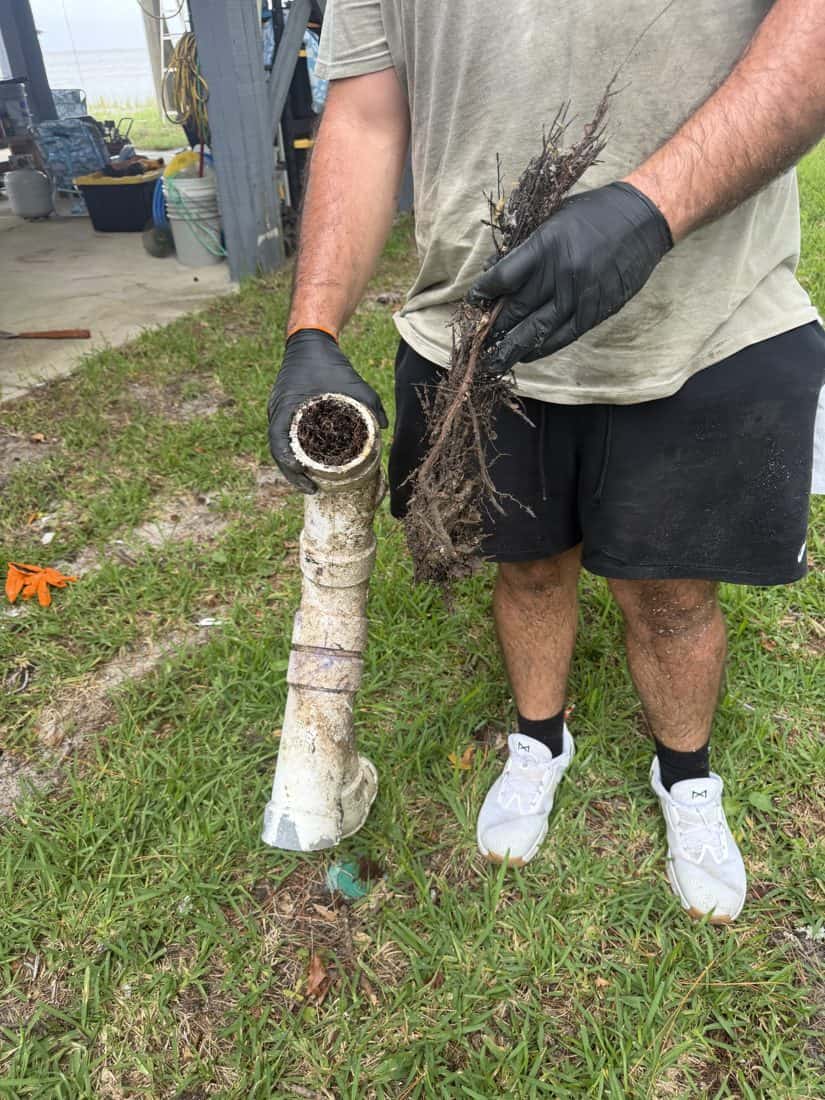
Yes. Roots seek out the moisture and nutrients in a sewer line, work into tiny joint gaps, and expand — eventually cracking the pipe and forming a mesh that catches everything flushed. Jetting clears them for now, but if the pipe is compromised, the roots come back until the line is repaired.