
Endless Hot Water. No Tank in the Way.
A tankless unit heats water on demand — no standby tank to keep hot around the clock, no running out mid-shower, and a fraction of the footprint. We install and service tankless systems for homes and rentals across Baldwin County. Licensed Alabama Master Plumber — MP-4462. Upfront pricing, and a 2-year warranty on our repair work.
- 01Diagnose
- 02Price
- 03Repair
Get a Free Estimate
Name and phone is all we need to call you back. Takes ~20 seconds.
37+ five-star reviews · Fast response · Licensed Master Plumber MP-4462
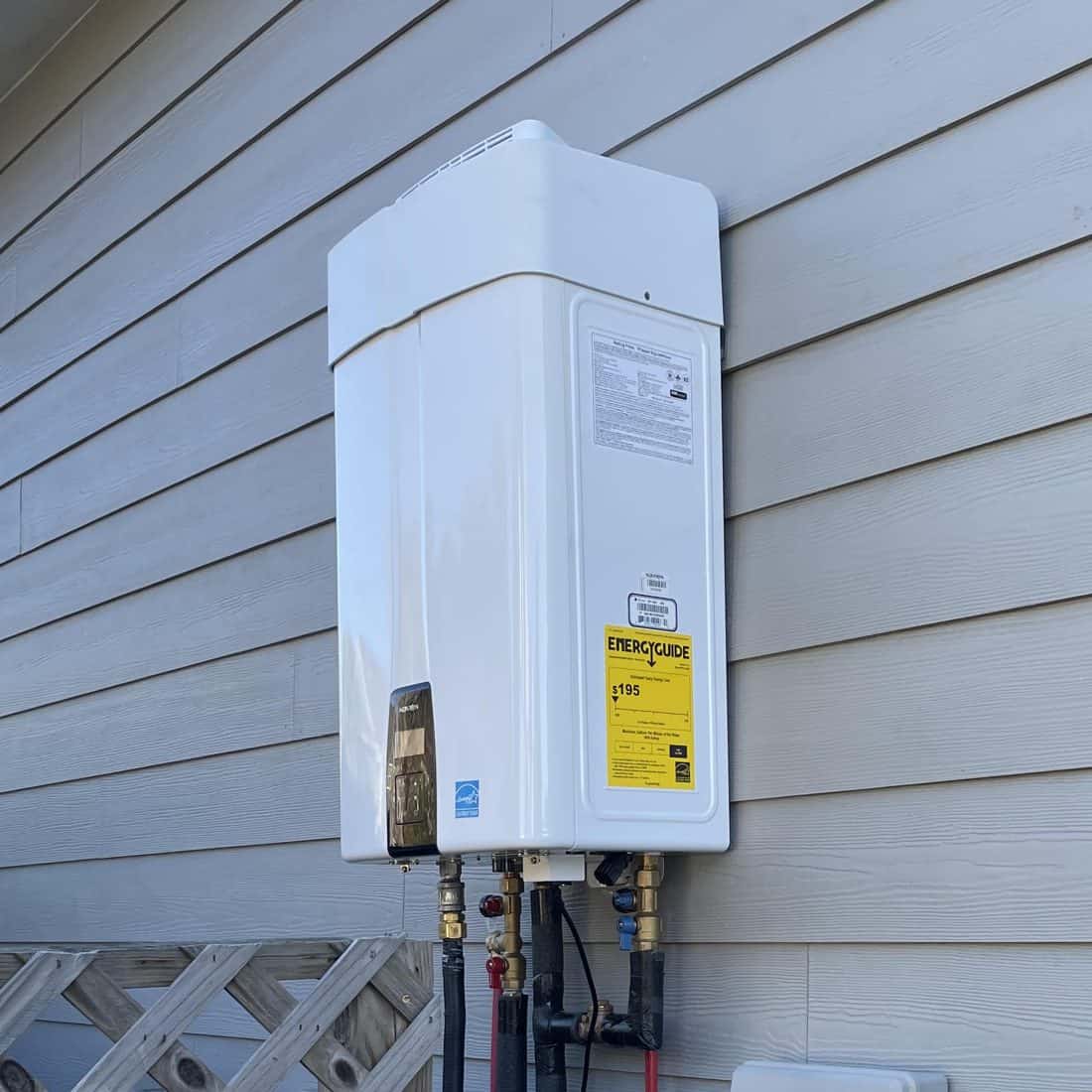
Tankless water heaters heat water only when you call for it, so you get a continuous supply without paying to keep a big tank hot 24/7. Streamlined Plumbing installs and services tankless systems across Baldwin County — a strong fit for busy households tired of running out, and for rentals where reclaiming closet space and cutting standby loss both matter. We'll tell you honestly whether your home is a good candidate before you commit.
Not sure tankless is right for you? Start with our full water heater services — we'll compare tank vs. tankless for your actual home and usage.
Tankless Done Right.
Tankless has real advantages, but only when it's sized and installed correctly for your home. We handle the whole job:
- New tankless water heater installation
- Tank-to-tankless conversions
- Sizing the unit to your household's real hot-water demand
- Tankless repair and diagnostics
- Descaling and maintenance to protect the unit from hard water
- Replacing an aging or undersized tankless system
- Point-of-use tankless for additions and far bathrooms
- Honest fit assessments — we'll say if a tank suits you better
What tankless water heaters actually turns on here.
Here is the number that ought to open any honest tankless conversation in Baldwin County. Add up the American Community Survey housing counts for the 19 communities on this site that carry a Census place record and you get 83,098 units, of which 58,775 were recorded as occupied. That leaves 24,323 — close to a third of that stock — standing empty at the moment of the survey. And it is not spread evenly. Orange Beach accounts for 11,144 of those and Gulf Shores for 7,406. A storage water heater is charged for standby whether or not there is anyone in the building to use the hot water it is holding. On-demand heating removes that charge entirely, because a unit that is not called on does not fire. That is the strongest argument for tankless anywhere in this county, and it is an argument about the address rather than about the product.
The second number is the one that decides whether a given unit will actually satisfy the house, and it is where tankless installs go wrong. Tankless capacity is a flow rating, not a volume — the question is not how much hot water you use in a day but how much you draw at the same instant. The ACS gives population and occupied units for each of these communities, and dividing one by the other gives a rough density figure that ranges from about 1.9 people per occupied unit in Point Clear to about 3.9 in Stapleton. That is a derived proxy from two separate tables rather than a published household statistic, and it should be read as a hint about the county rather than a fact about your address. But the spread is wide enough to make the point: the same model that comfortably runs a two-person bayfront house will disappoint a full house on an acre lot north of the interstate. Sizing is done from your fixtures and your habits, at your kitchen sink, not from a brochure.
Third, the maintenance story, which national marketing consistently gets backwards for this county. The standard tankless pitch and the standard tankless warning both revolve around scale: mineral coming out of solution inside the heat exchanger, descaling every so often to keep it clear. That is reasoning from mineral-rich supply. Baldwin County's raw groundwater, as recorded by the United States Geological Survey, sits at the other end of that scale. Take the hardness series first: 177 well samples, a midpoint of 12 mg/L as calcium carbonate, and 87 results in every hundred landing beneath the 60 mg/L line the USGS draws for soft water. On the grains scale a water-treatment salesman would quote, that midpoint is 0.70. The pH series is 248 samples deep with a midpoint of 5.90 and roughly four readings in five under neutral. Two honest qualifications, though, and they cut in opposite directions. These are raw well samples, not treated tap water, and 12 of the 22 communities are on a registered community water system where corrosion control is a Lead and Copper Rule duty, so what reaches those units has already been adjusted — Spanish Fort's registered system is recorded as surface-sourced rather than groundwater, which makes a well series the wrong reference there altogether. The hardness distribution also has a long tail — its extremes are 0.0 and 990.0 — and 13 samples in every hundred came back above the soft line, so a well owner assuming the county midpoint describes their own supply is gambling on it. Descaling is a per-property question, answered by a water test, not by a county headline in either direction.
Finally, the part of a tankless job that is not ours, said plainly rather than buried. The large majority of tankless units on the market are gas-fired, and there is no gas-fitter credential behind this business. We do not run gas line and we do not do venting. What we do is the water side — supply and return, isolation valves, the mounting, the connections, the flush ports, the unit itself — and we will tell you before a date is booked which portions of the job belong to a qualified gas fitter. Electric tankless carries its own boundary: whether your panel and service can carry the load is an electrician's determination, not a plumber's, and anyone who tells you otherwise on the phone has not looked. That leaves the honest fit assessment, which is the actual service on offer. For a great many Baldwin County properties tankless is the better answer, particularly the ones sitting empty for long stretches. For plenty of others a well-placed tank is the smarter money and we will say so. Brandon Byrd holds Alabama Master Plumber licence MP-4462, repair work carries a two-year warranty, and (251) 423-7654 is answered at any hour.
How this differs town to town
On this service the community-level facts that actually move a decision are how much of the local housing stock stands empty and how densely the occupied part is lived in — the first drives the standby-loss argument, the second drives the sizing. Both come from the American Community Survey. Robertsdale, Silverhill and Summerdale are not listed below: over nine in ten of their housing units were recorded occupied, so the vacancy half of this table has nothing to add for them. Their tankless cases are the general one made above.
- Orange Beach
15,075 housing units with 3,931 occupied — about 11,100 units sitting idle at survey time. Also carries the highest mapped marinas and hotels of the 22 communities Streamlined Plumbing serves at 18. If a tank is holding 50 gallons hot for an empty condo, that is the whole tankless argument in one sentence.
- Fort Morgan
The 36542 ZIP area that includes Fort Morgan holds the highest total housing units of the 22 communities Streamlined Plumbing serves at 18,551, against 7,947 occupied. Add 81 minutes of road each way and the case for a unit that needs less routine attention gets stronger on its own.
- Gulf Shores
14,668 units against 7,262 occupied — very close to half the stock idle at survey time — plus the highest mapped apartment/condo buildings of the 22 communities Streamlined Plumbing serves at 218 within roughly five kilometres of the town centre. In stacked buildings, venting and clearance decide feasibility long before capacity does.
- Stockton
320 units with 180 occupied, so nearly 44% of this stock was empty. Occupied households work out near 2.2 people on the derived proxy — small draws, long idle stretches, which is the profile on-demand heating fits best. No registered community system.
- Montrose
The 36559 ZIP area records 217 housing units and 141 occupied. Small numbers, but a 35% idle share and five minutes of road from the Fairhope shop make an on-site fit assessment easy to arrange before committing.
- Bon Secour
1,368 units against 1,102 occupied, and among the three lowest for owner-occupancy rate of the 21 communities Streamlined Plumbing serves at 65.6%. Where a property is let rather than lived in, the standby saving accrues to whoever pays the power bill — worth settling before the quote, not after.
- Loxley
1,620 units with 1,315 occupied, and the derived density proxy runs above 3 people per occupied unit. Denser occupancy means heavier simultaneous demand, and heavier simultaneous demand means a bigger flow rating, so this is a place where undersizing is the failure mode to guard against.
- Magnolia Springs
564 units, 460 occupied, and a construction midpoint of 1983 — the practical constraint here is usually where a wall-hung unit can go and how it vents out of an older building, not whether the household needs one.
- Perdido
249 units with 206 occupied and among the three highest for owner-occupancy rate of the 21 communities Streamlined Plumbing serves at 86.9%. Owner-occupiers pay for their own energy, which is the situation where a standby-loss argument actually lands.
- Elberta
1,140 units against 950 occupied, with a derived density around 2.3 people per occupied unit — modest simultaneous draw. Served by a registered system for 12,765 people, so the treated-water report rather than the raw well series is the document to ask for.
- Stapleton
The derived density proxy here comes out near 3.9 people per occupied unit across 790 housing units, at the top end of the range this calculation produces. That is a sizing problem before it is anything else, and it is why a brochure recommendation is not enough here.
- Point Clear
1,106 units, 968 occupied, and a derived density near 1.9 people per occupied unit. Light simultaneous demand plus the highest median home value of the 20 communities Streamlined Plumbing serves at $888,700 means the install detailing, not the capacity, is what the money buys.
- Foley
11,569 housing units with 10,323 occupied — a large, genuinely lived-in stock, so the vacancy argument barely applies. The tankless case here is space reclaimed and continuous supply for a household, judged on its own merits.
- Spanish Fort
4,338 units and 3,860 occupied — near-full occupancy — with 93 apartment or condo buildings mapped within about five kilometres of the town centre. The registered system is recorded as surface-sourced rather than groundwater, so a well-based descaling argument does not describe this supply.
- Daphne
11,801 units against 10,832 occupied, on the highest population of the 22 communities Streamlined Plumbing serves at 28,673. Nothing seasonal about this stock: the decision rests on simultaneous demand and where a unit can be mounted, not on standby loss to an empty house.
- Fairhope
10,360 units with 9,315 occupied and a derived density near 2.5 people per occupied unit. Two minutes from the shop, which makes it practical to measure the actual peak draw across your fixtures rather than estimate it — the step that decides whether a tankless install satisfies.
- Lillian
672 units with 642 occupied — barely any idle stock at all — and a derived density near 2.9. Full-time households with real simultaneous draws: this is a demand-sizing conversation and there is no vacancy saving to lean on.
- Rosinton
Across the 36567 ZIP area, 6,054 housing units with 5,645 occupied and a derived density near 2.7. No registered community system covers the area, so if descaling ends up being the question, a well test is the only way to answer it.
- Bay Minette
3,407 units, 3,050 occupied, and the lowest owner-occupancy rate of the 21 communities Streamlined Plumbing serves at 63.3%. In let property the person who buys the heater and the person who pays to run it are different people, which changes who the efficiency argument is aimed at.
Frequently Asked Questions About Tankless Water Heaters
What are the real advantages of going tankless?
Two big ones: endless hot water (it heats on demand, so you don't run out mid-shower) and no standby loss (you're not paying to keep a tank hot all day and night). They also take up far less space and typically last longer than a tank. For the right household, those add up.Will a tankless heater keep up with my whole house?
It will — if it's sized correctly. That's the key. A tankless unit is rated for a certain flow rate, so we size it to how much hot water your home actually uses at peak (say, two showers and the dishwasher at once). An undersized unit disappoints; a properly sized one keeps up fine. Sizing is where the install makes or breaks it.Do tankless heaters need maintenance?
Yes — and it matters here. Our water leaves scale behind, and scale is the enemy of a tankless unit's heat exchanger. Periodic descaling keeps it running efficiently and protects the warranty and lifespan. We can handle that maintenance as part of servicing the unit.Is tankless worth the higher upfront cost?
It depends on your home and how you use hot water. The upfront cost is higher than a tank, but you save on standby energy and gain endless hot water and space. For some homes it's clearly worth it; for others a good tank is the smarter money. We'll lay out the honest comparison for your situation rather than push one way.