
Your House Has a Number Nobody Has Ever Measured: Static Water Pressure
Alabama's plumbing code caps a building at 80 psi static. A threaded gauge on a hose bib tells you in thirty seconds whether yours is legal — and Daphne alone sits on three different water systems.
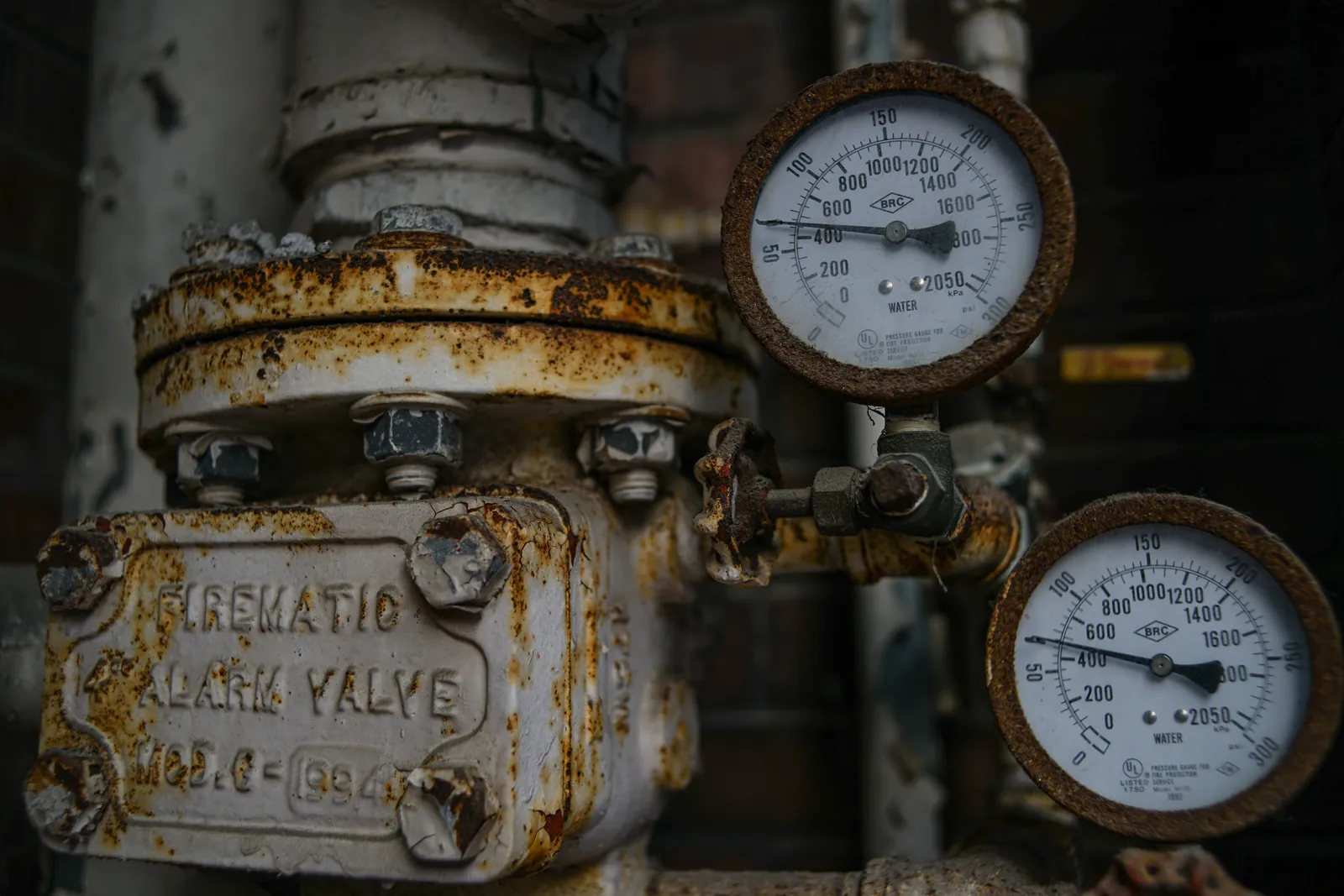
There is a number that governs how long everything in your plumbing lasts, and almost nobody in this county knows theirs. It is static water pressure — the pressure in the pipes when nothing is running — and Alabama's plumbing code caps it at 80 psi inside a building. Measuring it takes a threaded gauge, an outdoor hose bib and about thirty seconds. If the needle comes up past 80, you are outside the code and the clock is running faster on every fixture in the house.
Here is how to take the reading, and what to do with it.
The measurement
Buy a threaded water pressure gauge — the brass dial that screws onto a garden hose thread. Any hardware store carries them and they are not an investment.
Pick the hose bib closest to where the water service enters the house, because the further you get from the entry the more the reading reflects your own piping rather than the supply. Shut off everything using water — no ice maker filling, no irrigation zone running, nobody in the shower — screw the gauge on hand tight, and open the bib all the way. The needle jumps and settles.
Then do it twice more, at different times. Municipal distribution pressure is not a constant; it moves with demand, with tank levels and with whatever the utility is doing that week. A single reading is a data point. Three readings across a day is a picture. The overnight one is usually the highest, because demand across the system is at its lowest.
| Reading | What it means | What to do |
|---|---|---|
| Under 40 psi | Low. Fixtures will feel weak, particularly upstairs | Diagnose before assuming the supply — a restriction inside the house reads the same way |
| 40–60 psi | The comfortable band for most houses | Nothing. Write it on the water heater with a marker and move on |
| 60–80 psi | Legal but on the firm side | Fine. Worth re-checking annually if there is a regulator on the house |
| 80–100 psi | Over the code ceiling of 80 psi static | A pressure-reducing valve is required, or the existing one has drifted |
| Over 100 psi | Well over. Appliance hoses and fill valves are being used up | Get it dealt with; this is where washing-machine hoses let go |
| Needle climbs while nothing runs | Thermal expansion on a closed system | Code calls for an expansion tank — see below |
Why the reading changes so much across this county
Two reasons, and they compound.
The first is that Baldwin County is not on one water system. It is on many. Daphne alone sits on three registered community systems — the Utilities Board of the City of Daphne, serving 33,372; the Belforest Water System, serving 17,268; and the Park City Water Authority, serving 1,266. Two houses a mile apart, one in Lake Forest and one out toward French Settlement, can be on different utilities entirely, with different pumps, different tank elevations and different distribution pressure. There is no single "Daphne pressure" to quote at you.
The second is elevation, and this county has a great deal of it for a coastal one. A column of water exerts roughly 0.433 psi per foot of height, so every foot of difference between the supply tank and your tap is worth about half a psi. Daphne's town centre sits at about 160 feet on the bluffs above Mobile Bay; Spanish Fort at about 25; Gulf Shores at about 7; Bay Minette up at 271. Within a single pressure zone, the house at the bottom of the hill sees meaningfully more pressure than the house at the top — which is why a street can have one neighbour complaining about weak showers and another replacing a burst washing machine hose.
Take the Hwy 181 corridor as the everyday version of this: development spread east across ground that falls away toward the Fish River basin, on more than one utility, over a couple of decades. Pressure is not a neighbourhood property. It is an address property, which is why you measure yours rather than ask around.
The valve, and how it fails
A pressure-reducing valve is a bell-shaped brass body with an adjusting screw and a locknut on the top, sitting on the house side of the meter. It is a spring and a diaphragm, and both age.
When a PRV fails it usually fails open — meaning the house stops being protected and slowly drifts up toward whatever the street is doing. That is a failure you do not feel. Nothing leaks, nothing bangs, the shower just gets a bit better. Meanwhile every fill valve, cartridge and appliance hose in the building is working above its design pressure, and the first symptom is a component letting go somewhere inconvenient.
Adjusting one is a screw and a locknut and is within reach of a careful homeowner with a gauge on the line while they turn it. Replacing one is not a homeowner job, and the reason is what section 604.8 pairs with: the moment a PRV, check valve or backflow preventer is in the line, the house becomes a closed system, and the water heater's expansion has nowhere to go.
What is thermal expansion, and why does it matter here?
Water expands when you heat it. In an open system that extra volume pushes back out into the street main. In a closed system it cannot, so pressure climbs every time the water heater fires — sometimes far past the static reading you took.
The code anticipates exactly this. IPC section 607.3 requires that where a storage water heater is supplied with cold water passing through a check valve, pressure-reducing valve or backflow preventer, a thermal expansion tank be connected to the cold water supply downstream of all of them, sized to the manufacturer's instructions and holding the system within the 604.8 limit.
The tell that this is happening in your house is the T&P relief valve on the water heater weeping intermittently — usually a small puddle, usually blamed on the heater. It is often not the heater. It is the only pressure-relief device in the building doing the job the missing expansion tank should be doing, and it is not designed to do that repeatedly. That is water heater work with a pressure problem underneath it.
The other tell is noise. Water hammer — the bang when a washing machine valve or a single-lever faucet snaps shut — gets sharply worse as pressure rises, because you are stopping a faster-moving column of water. Arrestors help. Fixing the pressure helps more.
If the reading is low instead
Low is a different investigation, and the mistake is to treat it as the same one.
A whole-house low reading with a good supply usually means a restriction — a partly closed main, a clogged PRV strainer, or corroded and scaled interior pipe. A low reading at one fixture only is almost always local: an aerator, a cartridge, a stop valve someone bumped. The full diagnostic split between the two is on the low water pressure page, and it is worth reading before you conclude anything.
The version worth taking seriously is pressure that has fallen gradually over years in an older house. That is what dying supply pipe looks like from inside the building, and by the time flow is visibly worse the same pipe is generally not far from leaking. What that costs to put right is something you can size for yourself before you talk to anybody, and a whole-home repipe is the honest answer when the pipe itself is the restriction.
The other version worth taking seriously is a pressure drop that appeared suddenly with no explanation. If nothing changed and the pressure did, water is going somewhere, and leak detection finds it before the drywall does.
On a well, none of this applies the way you think
Ten of the 22 communities we cover have no active community water system registered with EPA. Those addresses run on a private well, a pump and a pressure tank, and there is no regulator because there is nothing to regulate down from.
What sets your pressure instead is the pressure switch: the pump cuts in at a low value and out at a high one, so your house lives between two numbers rather than at one. Put a gauge on the hose bib there and you will watch the needle swing. That is normal. What is not normal is a very short cycle — the pump kicking on and off every few seconds — which usually means a waterlogged pressure tank, and I will say plainly that wells and well pumps are not our work. That is a licensed well and pump contractor. Everything downstream of the pressure tank — the interior lines, the fixtures, the faucets, the water heater — is ours.
Take the reading first either way. It costs nothing and it explains a surprising amount. If it comes back high, or the T&P valve has been weeping, call us at (251) 423-7654. Brandon Byrd, Alabama Master Plumber MP-4462.
A swinging supply pressure is also the usual reason a shower temperature wanders, which is worth knowing before you condemn a cartridge — see the shower head and tub valve piece.
Sources. Alabama Plumbing Code 2015, which adopts the 2015 International Plumbing Code without amendments — IPC §604.8 (80 psi static ceiling; ASSE 1003 / CSA B356 pressure-reducing valve with strainer) and §607.3 (thermal expansion tank required downstream of check valves, pressure-reducing valves and backflow preventers). Community water system names and populations served from the EPA SDWIS drinking-water registry. Ground elevations from USGS 3DEP point queries. Static head of approximately 0.433 psi per vertical foot is the standard hydraulic conversion (2.31 feet of water column per psi).