
Should You Drip Your Faucets? Here, the Answer Changes Overnight.
Dripping is right during a freeze and wrong the morning after — ADEM asked Alabamians to stop once temperatures rose. On systems as small as Baldwin County's, that matters.
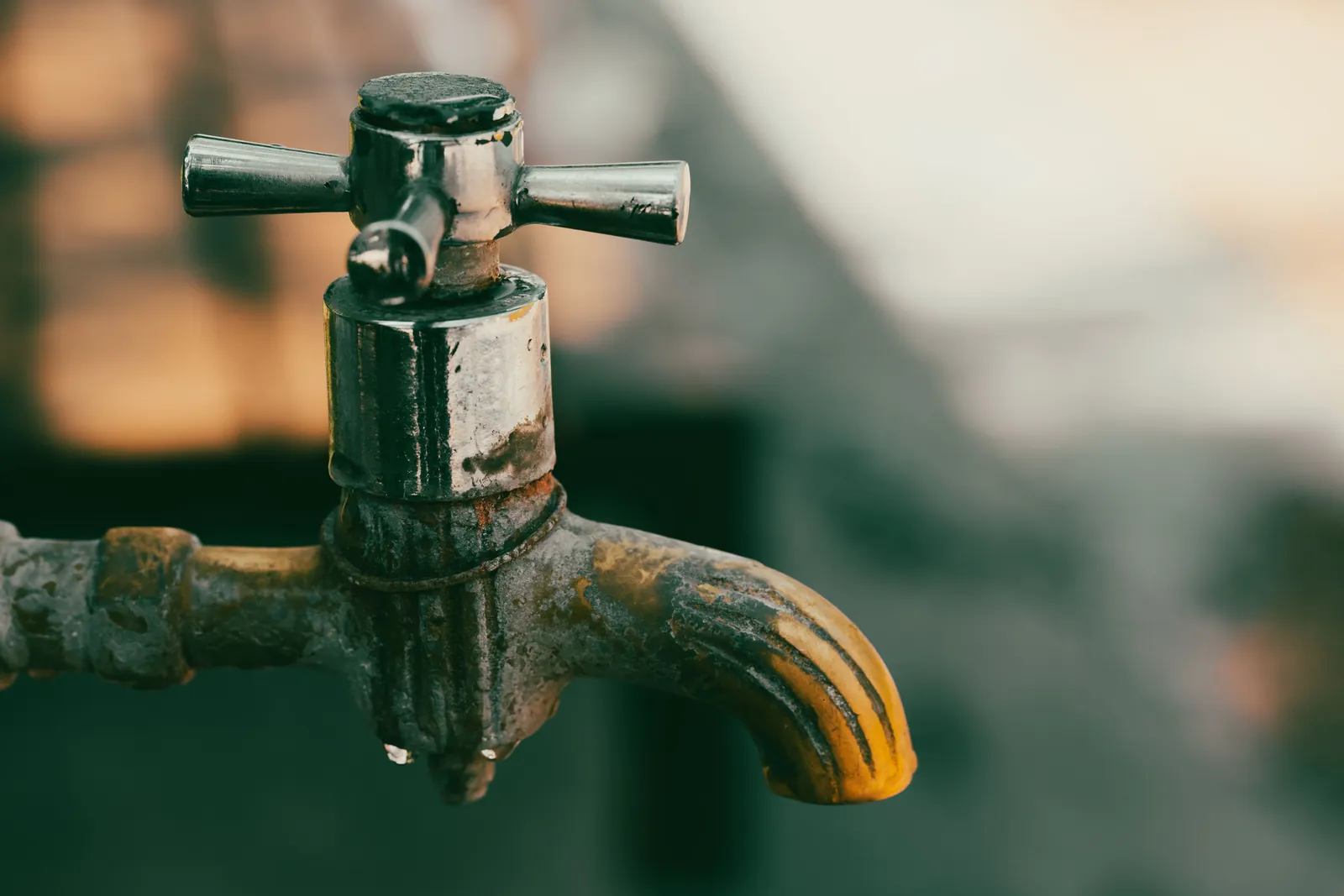
Dripping your faucets is good advice for about thirty-six hours a year in Baldwin County, and bad advice immediately afterwards. That second half is missing from nearly every article you will find, and it has a documented Alabama origin: after the December 2022 freeze, the state environmental agency publicly asked residents to stop dripping once temperatures rose back above freezing, because so many people were still doing it that water systems were losing storage and pressure.
That makes this a two-part question, not a yes-or-no one.
Does dripping actually stop a pipe from freezing?
No. It buys you a different kind of protection, and it is worth understanding which.
When a length of pipe freezes, the ice plug itself is rarely what splits it. What splits it is pressure. Water keeps expanding behind the growing plug, that pressure has nowhere to go because the faucet at the end of the run is closed, and the pipe fails at whatever point is weakest — commonly downstream of the ice, sometimes several feet away from it. An open faucet gives that pressure an exit.
A plumber in Mobile said the honest version out loud during the 2022 event: if it gets cold enough, it will bypass that trickle, "because rivers freeze too." Moving water freezes. A trickle in an unheated attic at 12°F is not a force field.
So: drip because it relieves pressure, not because you believe it prevents ice. That distinction changes what you do — it means you also insulate, also disconnect the hoses, and also know where the shutoff is, instead of treating a running tap as the whole plan.
The part specific to Baldwin County: the systems here are small
This is where the advice stops being generic. The reason the state asked people to stop dripping is that a lot of Alabama runs on small water systems, and a small system has small storage.
Take the two ends of our own service area. The Summerdale water board is registered with EPA to serve 1,800 people — the lowest population served by the local water system of the 12 communities Streamlined Plumbing serves. The City of Fairhope's system is registered for 59,850. That is a thirty-three-to-one difference in the size of the pot, sitting inside one county.
Now imagine a meaningful share of the connections on the smaller of those two running a continuous stream for forty-eight hours after the cold has already passed. Nobody has to be careless for that to add up; everybody just has to forget to turn it off. Statewide in December 2022, ADEM reported multiple systems losing pressure, and Selma declared a state of emergency over it. Here in January 2025, North Baldwin Utilities issued a six-day boil-water notice citing excessive leaks after extreme winter weather followed by thawing.
Losing system pressure is not a minor inconvenience either. It is the mechanism behind boil-water notices — when a distribution main drops below about 20 psi, outside water can move into the pipe through cracks and joints. Dripping past the point of usefulness is one of the few things a homeowner does that can nudge a whole neighbourhood toward that.
How to drip properly, if you are going to do it
Pick the right fixture, not the convenient one
The faucet farthest from where the water enters the house, ideally on an exterior wall and on the north or west side. That puts moving water through the longest and coldest stretch of the run. The kitchen sink is usually neither.Open hot and cold, slightly
Both supply lines are exposed, not just the cold one. A thin steady stream from each side beats a fast trickle from one. If the fixture is a single-handle mixer, set it to the middle.Open the cabinet doors under sinks on exterior walls
Vanity and sink cabinets on an outside wall are the coldest interior spot in most houses. Opening the doors lets room air reach the supply lines and the trap. Move anything a child or pet should not reach first.Turn it off when the forecast clears freezing
This is the step ADEM asked for by name. Once the daytime high is comfortably above 32°F and the next night is not going below it, shut them off.
On a private well, the arithmetic is different
About 28,802 Baldwin County residents — roughly 14% of the county — are self-supplied by private wells, and out in the Summerdale area, along the Hwy 59 corridor and across the agricultural land east of it, that share runs higher than the county figure.
If that is you, dripping is not drawing down a municipal tank. It is cycling your own pump. Every few gallons, the pressure tank drops and the pump kicks on, all night, for as long as you leave the taps open — and the pump, the pressure switch and the tank are frequently in a well house or an unheated outbuilding, which is exactly the equipment most at risk on the same night.
We do not install or repair wells or well pumps; that is a licensed well and pump contractor's work, and I would rather tell you that now than after you have called. What is ours is everything downstream of the pressure tank — the interior lines, the fixtures, the filters and the water heater. If a freeze takes out something on the house side, that is water line repair and leak detection work.
When the dripping does not stop on its own
Every year, cold weather is when people discover which of their fixtures no longer close. If a tap is still dripping after you turned it off, the cartridge, seat or washer is worn, and no amount of handle-tightening fixes it — it usually makes the seat worse. That is faucet and fixture repair, it is quick, and it is a much better thing to have handled in October than to be relying on in January.
The other item to settle before December: find your main shutoff valve and prove it closes all the way. In this humidity, valves that have not moved in a decade often will not, and the night you need it is the night you find out.
We answer around the clock at (251) 423-7654 — emergency plumbing when something has already opened up. Brandon Byrd, Alabama Master Plumber MP-4462. The rest of the seasonal checklist is on the freeze prep page.
Where in this county those cold nights actually land is worth knowing before you decide how hard to prepare — see inland Baldwin County is colder than the beach. And what to do in the hours after something lets go is in after the freeze: burst pipe triage.
Sources. Alabama Department of Environmental Management guidance to end faucet drips once temperatures rose above freezing, December 2022, via WSFA and AL.com. Mobile plumber quotation, WPMI/NBC 15, December 2022. North Baldwin Utilities boil-water notice, January 2025. EPA, "Loss of Pressure in Drinking Water Systems," on sub-20-psi intrusion and backsiphonage. Population-served figures from the EPA SDWIS drinking-water registry. Private-well population from ADECA's Alabama water-use report (Table 27). Freeze figures elsewhere on this site are per-coordinate ERA5-Land reanalysis for calendar year 2025 — a single year of measurement, not a climate normal.