
One of These Is a Fifteen-Minute Job. The Other Has No Shutoff Behind It.
Swapping a shower head is genuinely easy. Changing a tub or shower valve cartridge means shutting the whole house down — and in Magnolia Springs that means finding the breaker for your own well pump.
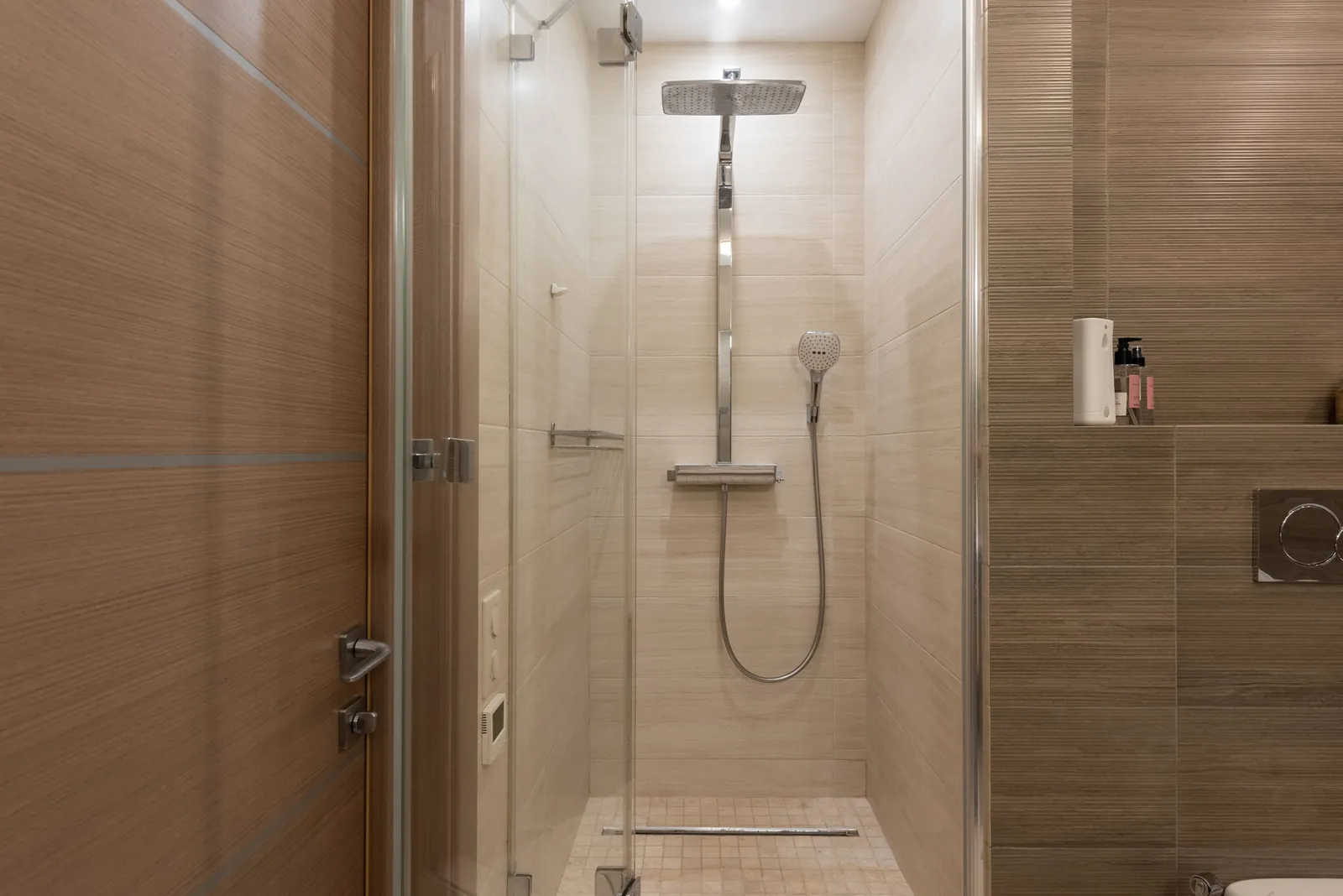
These two jobs sit next to each other in the same bathroom and they are not in the same category. A shower head unscrews from a threaded arm with the valve already shut, takes fifteen minutes, and the worst case is that you buy another one. A dripping tub or shower valve requires shutting off the water to the whole building, working blind inside a wall cavity on a valve body you cannot inspect, and it can end with a soldered joint and an access panel. Knowing which one you are starting is the whole point.
Here is each, honestly.
Job one: the shower head
There is genuinely nothing to this, and one way to get it wrong.
Hold the arm, turn the head
Put one hand firmly on the shower arm — the pipe curving out of the wall — so it cannot rotate, and turn the head counter-clockwise. If the head is stubborn, pad it with a cloth and use a wrench, still holding the arm. The arm must not move.Clean the threads properly
Old tape, old sealant and grit all come off. A wire brush or a rag and a fingernail is enough. Anything left behind is a leak path, and a leak at a shower arm runs into the wall rather than into the tub.Tape in the right direction
Two or three wraps of plumber's tape, applied clockwise as you look at the end of the thread — the same direction the new head will turn. Tape wound the wrong way unwinds itself as you thread the fitting on and does nothing.Hand tight, plus a nudge
Thread the new head on by hand until it stops, then a small amount more with a padded wrench. These are plastic or thin brass threads and they strip easily. If it weeps, another quarter turn — not another wrap and a heave.
The one way to get it wrong is in step one. That arm threads into a fitting inside the wall you cannot see, cannot hold and cannot reach. If it turns while you are working, you may be backing it out of that fitting, and the resulting leak happens inside the cavity, quietly, above the tub — the kind of thing that shows up months later as a stain on a ceiling below. Hold the arm.
Two practical notes while you are up there. Everything sold new in the United States is capped at 2.5 gallons per minute under the Energy Policy Act of 1992, in force since 1994, and a WaterSense-labelled head is 2.0 or less. And if the head has been running weak, take the face off and look before you replace it: in most of this county what blinds an aerator or a shower face is not lime scale — Baldwin's raw groundwater has a median hardness of 12 mg/L, with 87% of well samples below the USGS soft threshold — it is fine sand and iron off a well. Different deposit, different fix, and a five-minute clean rather than a purchase.
A sink has two shutoffs under it. A tub has none. That single fact is why one of these jobs is a Saturday and the other is a decision.
Job two: the tub or shower valve
A dripping tub spout after the handle is off means the valve is not closing fully — worn cartridge, worn seats and springs, or a scored valve body. On a sink you would close the angle stops underneath and take your time. On a tub, there are no angle stops, because the valve is buried in the wall. You shut off the house.
That changes the job in three ways worth understanding before you start.
You are working against a clock you set yourself. Everyone in the building is without water until you finish. That is a bad state to be in when you discover the replacement cartridge is not the one your valve takes, which happens constantly — there are dozens of cartridge families and a great many of them look similar on the shelf. Take the old one to the counter, or identify the valve brand first.
You may not be able to get the old one out. A cartridge that has sat in the same position for fifteen years, in water, seizes into the brass. Cartridge pullers exist for exactly this and they still sometimes lose. The failure mode is not "cartridge stays in" — it is "cartridge comes out in pieces, or the valve body is damaged getting it out," and a damaged valve body inside a tiled wall is a very different afternoon.
The vintage matters more than the brand. Magnolia Springs has a median year built of 1983. In stock of that age you frequently find two-handle valves with separate hot and cold stems, rubber seats and springs — mechanically simple, genuinely repairable, and often cheaper to rebuild than replace. In houses built after the 2015 code adoption you find single-lever balanced-pressure or thermostatic valves, which are better fixtures and less forgiving of improvisation.
What is different about doing this on a well?
Quite a lot, and it starts with the shutoff.
EPA's registry lists no active community water system for Magnolia Springs, and ten of the 22 communities we serve are in the same position — Bon Secour, Fort Morgan, Lillian, Magnolia Springs, Montrose, Perdido, Point Clear, Rosinton, Stapleton and Stockton. Out along the Magnolia River, in the shade of those live oaks, over toward Weeks Bay and up into the Fish River area, "shut the water off to the house" does not mean a curb key. It means your own main shutoff valve and, sensibly, the breaker for the well pump, so the pump is not cycling against an open line while you work.
The second difference is the pressure your valve is fighting. On a utility connection, the Alabama code caps the building at 80 psi static and a pressure-reducing valve holds it there. On a well there is no regulator — the pressure switch cuts the pump in at a low value and out at a high one, so supply pressure sweeps between two numbers continuously. A balanced-pressure shower valve is a device whose entire job is holding a temperature steady while the pressure on one side moves, and a well cycling underneath it is a harder assignment than a regulated municipal grid. If your shower temperature wanders and you are on a well, look at the pressure tank before you condemn the cartridge — and take the reading rather than guessing at it.
Wells and well pumps are not our work, and I would rather tell you that here than after a call. Everything downstream of the pressure tank is.
The stop signs
Stop and call if the shower arm rotated in the wall. Stop if the cartridge will not come out with a proper puller. Stop if there is no access panel behind the valve and the plumbing is soldered copper, because getting a torch into a stud bay with insulation and old framing is a fire problem before it is a plumbing problem. Stop if the drip continues with a brand-new cartridge, because the seat inside the body is the fault and no part you can buy will seal against it.
And stop if the tub spout drips while the shower runs, or the shower dribbles while the tub runs. That is the diverter, not the valve, and it is a different repair.
A drip is never just a drip financially — the arithmetic on a fixture that never quite closes surprises people, and a faucet that will not shut off is one of the few plumbing faults that bills you continuously. If pressure across the whole house has also fallen away over the years, the fixtures are not the story; that is old supply pipe narrowing from the inside, and the low pressure page walks the difference.
We do faucet and fixture repair across the county, we do leak detection when the water is going somewhere you cannot see, and we answer around the clock at (251) 423-7654 for emergency plumbing. Brandon Byrd, Alabama Master Plumber MP-4462.
Sources. Federal maximum showerhead flow rate of 2.5 gallons per minute, Energy Policy Act of 1992, effective 1994; EPA WaterSense showerhead specification of 2.0 gpm or less. Alabama Plumbing Code 2015, which adopts the 2015 International Plumbing Code without amendments — §424.3 (shower and tub-shower valve types, referenced ASSE/ASME standards, and the 120°F maximum-setting limiter) and §604.8 (80 psi static ceiling). Groundwater hardness (median 12 mg/L as CaCO₃, n=177, 87% below the USGS 60 mg/L soft threshold) from the USGS Water Quality Portal, Baldwin County well samples — raw groundwater, not treated tap water. Community water system status from the EPA SDWIS drinking-water registry. Median year built from Census ACS 2023 5-year estimates at place level.