
You Replaced the Wax Ring and It Still Leaks. The Ring Was Never the Problem.
A wax ring seals a gap it can bridge, not one it has to span. In most Baldwin County houses the real fault is flange height — and a thicker ring makes that worse rather than better.
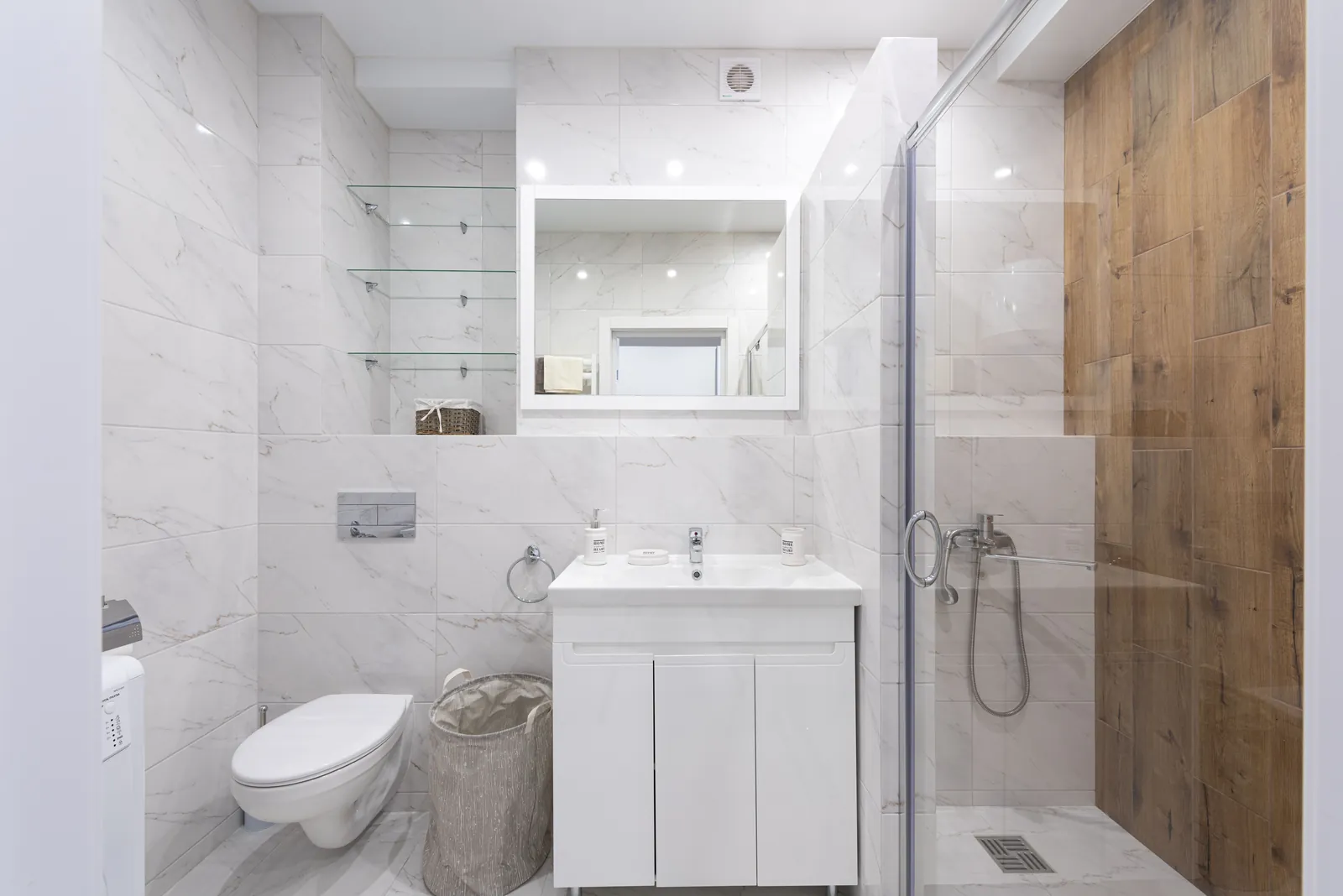
A wax ring is a gasket, not a bridge. It seals the joint between the toilet's outlet and the flange in the floor by cold-flowing into a gap it can span — a fraction of an inch, no more. If the leak came back after you spent a Saturday replacing it, the ring almost certainly did its job, and the geometry underneath it did not. By a wide margin the most common fault is a flange sitting below the level of the finished floor.
Here is what is actually under there, and how to work out which of six things you are looking at.
What the wax does, and why it only does it once
Two parts matter. The horn is the short spout on the underside of the bowl, where waste leaves the fixture. The flange is the collar anchored to the floor, holding the closet bolts and connecting to the drain below. The wax ring sits between them and gets squeezed.
That squeeze is the whole mechanism. Lowering the toilet presses the horn down into the wax, which deforms and takes the precise shape of the space between the two surfaces. It holds that shape permanently. Wax does not spring back.
Which produces the failure almost nobody is warned about: a wax ring seals once. Lift the toilet after setting it — to straighten it, to reseat a shim, to get a closet bolt to line up — and the wax stays compressed while the parts move. Put the bowl back down and the deformed wax no longer matches the gap it was formed to. It leaks, usually within days.
The same applies to twisting. Set the bowl straight down onto the bolts, press it home, and stop. Rotating it to square it against the wall shears the ring across its face.
The flange is below the finished floor
This is the answer most of the time, and it has a simple cause: floors get added, never removed.
The correct relationship is a flange rim level with the finished floor, or slightly proud of it. Set that way, the ring fills a shallow gap and gets compressed against a hard rim that confines it on all sides. Now put tile over the old vinyl, or luxury vinyl plank over the tile — normal at least once in any thirty-year-old bathroom, and twice in coastal rental stock refreshed between owners. The floor rises. The flange, set into the slab or screwed to the subfloor, does not.
The wax is now asked to span half an inch or more of open space with nothing holding it in. It will do that for a while, because wax deforms slowly. Then it extrudes sideways under the load, thins in the middle, and the joint opens. Weeks, not days — which is why people replace the ring, get a month of dry floor, and conclude they did the job wrong.
The six causes, and what each one looks like
| Cause | What you notice | What it actually takes |
|---|---|---|
| Flange below the finished floor | Dry for weeks, then water at the base on flush | Extender ring to raise the rim, then a standard wax ring |
| Broken or corroded flange ears | Toilet rocks; a closet bolt spins or pulls upward when tightened | Repair ring over the flange, or flange replacement |
| Toilet lifted and re-set on used wax | Leaked from the first flush or within days | Fresh ring, one set, no lifting and no twisting |
| Wrong ring for the fixture | Leaks immediately, with the toilet sitting solid | Match the ring to the horn — with or without the plastic funnel |
| Damaged or short horn | Slow seep, worse on a full flush than a light one | Inspection with the toilet on its side before anything else is bought |
| Cast iron closet bend rusted at the joint | Rust flakes at the joint, damp subfloor all around the base | Cut out and replace the flange and bend section |
Note that two of those are not wax-ring problems at all. A flange with cracked ears cannot hold the toilet down, and a toilet that is not held down moves every time somebody sits on it — which breaks any seal, however new.
Is it even the wax ring?
Before you pull the toilet a third time, spend an hour proving where the water comes from.
Dry the floor, the outside of the tank and the supply connection completely. Lay paper towel around the base, under the tank and beneath the angle stop. Then leave it alone without flushing.
Water that shows up anyway is not the seal. It is condensation, or the supply side. Condensation is a genuine Gulf Coast answer rather than a technicality: a tank full of cool groundwater in a bathroom running at summer humidity sweats steadily, runs down the china, and pools in a ring around the base that is indistinguishable from a failed seal. The tank-to-bowl gasket and the closet bolts through the tank are the other candidates, and those sit alongside the two tank parts that genuinely are a homeowner job in the flapper and fill valve piece.
Water only on flush, appearing at the base and nowhere else, is the seal or the flange.
What the slab changes
A lot of Baldwin County housing is slab-on-grade, and more of it every year — Foley carries a median year built of 2004 and Loxley 2007. On a slab there is no wood subfloor to screw a new flange into. The drain riser comes up through concrete and the flange sits on that riser, often glued or caulked in.
That changes the options rather than the diagnosis. A repair ring bolted over a sound flange, or an inside-fit flange seated down into the pipe, solves most of it. The bad case is a riser cut too short or a bend that failed below the surface, and that means breaking concrete. Which is why the honest answer to "can I just replace the flange" in a slab house is that somebody has to look first. Toilet repair work here splits fairly cleanly between the two.
Raised floors are the older stock, and they bring the opposite problem. Fairhope has a median year built of 1997, but the pre-1970 houses inside that average have cast iron closet bends under them, and cast iron flange ears rust thin from beneath where nothing shows. They break at the exact moment a closet bolt is tightened, which feels like something you did and is not.
What a repeat leak has already cost
Water at a toilet base does not run somewhere visible. It goes down between the flooring layers, into the subfloor, and then it stays — because in this climate nothing under a bathroom floor dries out on its own.
A floor that gives slightly at the base, a stain on a ceiling below, or a sewage smell that returns a day after cleaning are all past the point where the seal is the interesting question. At that stage the useful work is finding the full extent of what got wet, which is leak detection rather than toilet work.
The stopping rule
Two attempts. If you have set the toilet twice on fresh wax, without lifting it afterwards, and it still leaks, the problem is dimensional or structural. A third ring cannot change a dimension.
Pull it, measure the flange against the floor, and look at the ears and the horn while the bowl is on its side. That inspection takes five minutes and it decides everything that follows. If it shows a broken flange in concrete or a bend rusted through, that is emergency plumbing territory the moment the water cannot be shut off — and if you are already there, close the angle stop behind the toilet and stop flushing.
(251) 423-7654, any hour. Brandon Byrd, Alabama Master Plumber MP-4462.
Sources. Median year built for Foley, Loxley and Fairhope from Census ACS 2023 5-year estimates at place level. The wax ring behaviour described here is the standard mechanism of a compressed, non-elastic gasket; flange height relative to finished floor, and the requirement that a closet flange be secured to the structure, follow standard residential plumbing practice.