
How to Unclog a Toilet — and the One Question That Decides Whether You Should
The plunger most Baldwin County homes own is the wrong shape for a toilet. Here is the sequence that works, and the single check that tells you to stop plunging and pick up the phone.
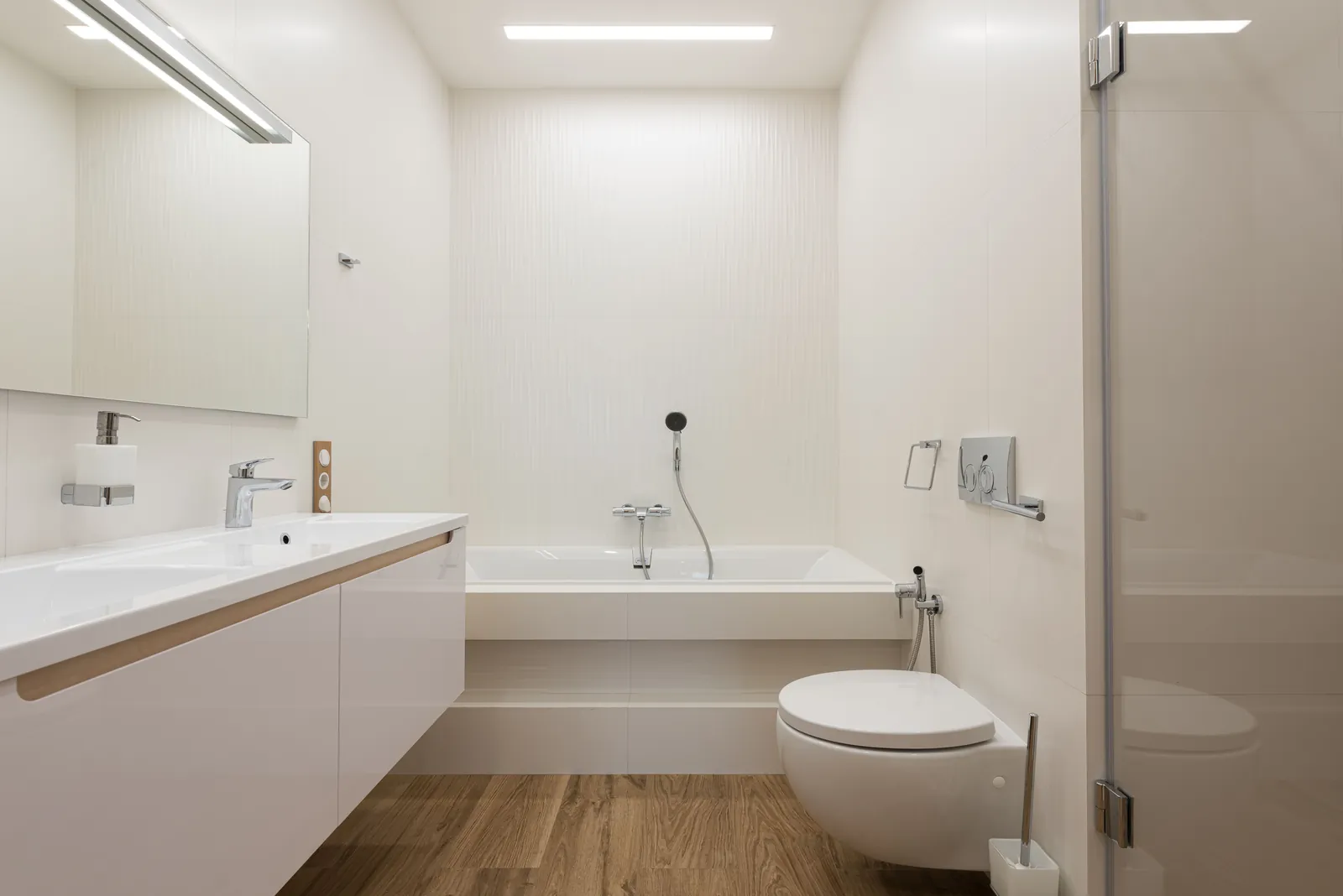
Most people fail at this before they start, because the plunger under the sink is the wrong shape. A toilet needs a flange plunger — the one with a soft rubber sleeve that folds down out of the cup — so it can seat inside the curved outlet at the bottom of the bowl. The flat cup plunger sold for sinks cannot seal against that curve, so every push leaks pressure sideways and nothing happens. Get the right tool and most single-toilet clogs are a two-minute job.
The rest of this is the sequence, and the one check that tells you to stop.
Before you touch anything: turn the water off at the toilet
There is a small oval or football-shaped handle on the wall behind the toilet, low down, on the supply line. Close it, clockwise, all the way. If the bowl is already near the rim, this is what stops the next flush from putting water on the floor while you work — and the next flush is the mistake almost everybody makes.
If that valve will not turn, do not force it. In this humidity, a stop valve that has not moved since the house was built often will not, and snapping the stem off a live supply line turns a clogged toilet into a wet ceiling. Lift the tank lid instead and push the flapper down by hand, or lift the float arm to stop the fill. Then put a working angle stop on the list.
The sequence that actually works
Get the water level right
You want enough water in the bowl to cover the plunger cup completely, and no more. Too little and you are compressing air, which does nothing. Too much and you are about to wear it. Bail into a bucket or add hot tap water as needed.Seat the flange, then push out the air
Fold the sleeve down, set it into the drain opening, and press slowly on the first stroke to expel the trapped air rather than launching the contents of the bowl at yourself. After that first slow push, keep the seal and work it.Pull as hard as you push
The clog moves on the upstroke at least as often as the down. A plunger is a two-way pump, and treating it as a hammer is why people get tired and nothing shifts. Fifteen to twenty firm cycles, keeping the seal the whole time.Break the seal and watch
Pull the plunger clear. If the water drops away fast, you are done — turn the supply back on and flush once to confirm. If it drains slowly, repeat the cycle; a partial clear usually finishes on the second round.Stop at about two minutes
If a properly seated flange plunger has not moved it in two solid minutes, it is not going to. The next tool is a closet auger, which is a short cable in a plastic sleeve made specifically to go around a toilet trap without scratching the glaze. A drain snake from the garage is not that tool.
When does a toilet clog stop being a toilet problem?
This is the question, and it takes ten seconds to answer.
With the toilet still blocked, go to another bathroom or the kitchen and run water. Fill a sink, then let it out. Run the tub.
If everything else drains fast and silent, the blockage is inside that one toilet's trapway and you are in the right fight. If something else gurgles, drains slowly, or — the bad one — if water rises somewhere else while you plunge, then the restriction is downstream in a line that several fixtures share. Plunging a toilet at that point does not clear anything. It just pushes a shared blockage a few feet further along and picks which fixture overflows first, which will be the lowest one in the house.
That is a main line call, and the honest advice is to stop running water entirely until someone has a camera in the line. Our drain cleaning work starts with looking rather than guessing, for exactly this reason.
Three things that make this county different
A lot of addresses here are on a pressure sewer, not a gravity one. Down at the water — Gulf Shores sits at about 7 feet of ground elevation, Orange Beach about 11, Fort Morgan under 3, against 271 feet at Bay Minette — there is often not enough fall to run sewage anywhere by gravity, so the house has a grinder pump in the yard doing the work instead. Plunging the toilet is still fine; the diagnosis changes. If several fixtures misbehave together on a grinder property, the suspect list starts at the pump, not the trapway.
Ten of the 22 communities we cover have no active community water system registered with EPA at all. Bon Secour, Fort Morgan, Lillian, Magnolia Springs, Montrose, Perdido, Point Clear, Rosinton, Stapleton and Stockton are served by private wells — and an address on a private well is usually on a private septic system too. A recurring toilet backup out there can be a full tank rather than a clog, and I will say plainly that we do not pump septic tanks. That is a septic contractor's work, and you want to know that before you pay someone to snake a line that was never blocked.
The older stock is where the odd clogs live. Fairhope is on a single municipal system registered to serve 59,850 people and its median year built is 1997, so most of the town — the subdivisions out along Greeno Road, the newer work east of town — is modern plumbing. Walk downtown toward the Pier, or south along Scenic 98 through Montrose and Point Clear on the Mobile Bay shoreline, and the vintage changes underfoot. Perdido's median year built is 1979 and Magnolia Springs' is 1983. In houses of that age you find original cast iron laterals with a rough interior, and a rough interior catches things a smooth one passes.
What a plunger will never clear
Some blockages are not soft, and no amount of pressure changes that.
A wipe — including every "flushable" one — does not break down the way paper does; it wads and it stays wadded. Dental floss and hair braid into a net that everything else then catches on. Anything a child has posted through the seat is a foreign object, and the honest answer there is usually pulling the toilet, which also means a new wax ring going back down. And a build-up of scale on the trapway walls narrows the passage permanently; it will clog again next month no matter how well you plunge it today.
If the same toilet blocks more than about twice a year, the clog is a symptom rather than an event. Either the fixture's trapway is restricted, or the line it drains into is. A slow drain elsewhere in the house at the same time points hard at the second one, and a camera settles it in a few minutes. Our sewer line work is almost always a repair of something a homeowner had been clearing manually for a year.
Not sure which side of the line you are on? The symptom checker walks the same questions I would ask you on the phone.
If it is already over the rim, shut the supply valve, shut the main if you have to, and call. We answer around the clock at (251) 423-7654 — emergency plumbing when it has already got away from you. Brandon Byrd, Alabama Master Plumber MP-4462.
No plunger in the house and it is late? That is a different set of options, most of which can break something — ranked by risk here. And the other half of a toilet's working life is the leak rather than the clog: the two tank parts worth replacing yourself are covered in the flapper and fill valve piece.
Sources. Federal maximum flush volume of 1.6 gallons per flush, established by the Energy Policy Act of 1992 and effective in 1994; EPA WaterSense high-efficiency specification of 1.28 gpf. Population served and community water system status from the EPA SDWIS drinking-water registry (10 of the 22 communities in our service area have no active registered community system). Ground elevations from USGS 3DEP point queries. Median year built from Census ACS 2023 5-year estimates at place level.