
The Two Toilet Parts You Can Replace Yourself — and What a Worn One Costs Here
A flapper and a fill valve are the only tank parts most homeowners should touch. On a water system registered to serve 1,800 people, or on your own well pump, a silent leak is not a rounding error.
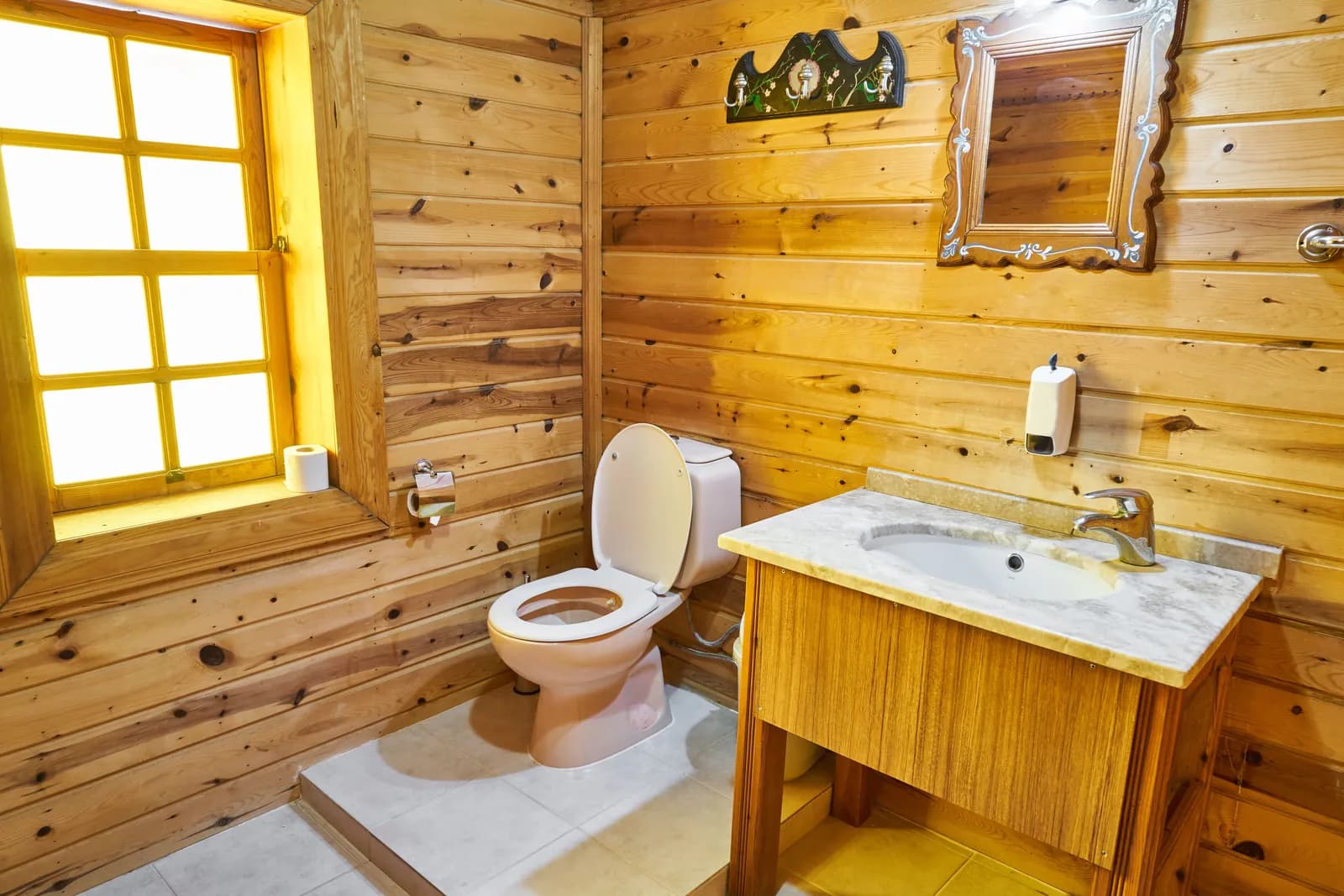
There are exactly two parts inside a toilet tank that a homeowner should replace, and between them they cause most of the water this county quietly loses. The flapper is the rubber seal at the bottom of the tank; when it stops sealing, water runs from tank to bowl forever and you may never hear a thing. The fill valve is the tower on the left that refills the tank; when it fails, it either never shuts off or it cycles on its own. Both are cheap, both are hand-tool jobs, and both are worth doing the week you notice them.
Everything else in that porcelain is a different conversation.
Find out whether you have a leak at all
Not every toilet that annoys you is leaking, and plenty of toilets that leak never make a sound. The test is the same either way and takes twenty minutes of waiting.
Colour the tank
Lift the lid, drop about ten drops of food colouring into the tank water, and stir it once. Do not flush. Put the lid back so nobody in the house helpfully flushes it for you.Wait, and then look in the bowl
Fifteen to twenty minutes. Any colour at all in the bowl means water is passing the flapper seal. There is no acceptable amount — a seal either seals or it does not.Watch the fill valve separately
Stand in the bathroom for a couple of minutes with the house quiet. A toilet that refills briefly on its own with no dye transfer is losing water somewhere else, usually past a fill valve that will not fully close, spilling down the overflow tube.Check the water level against the overflow
The tank level should sit roughly an inch below the top of the overflow tube. At or above it, water is running continuously down the tube and out — silently, because it never disturbs the surface of the bowl.
If the dye moves, you are replacing a flapper. If the level is high or the valve hisses, you are replacing a fill valve. If both, buy both; they are usually sold as a pair for a reason.
What that leak is actually costing
EPA's WaterSense programme puts the national numbers plainly: household leaks waste nearly one trillion gallons of water annually across the country, the average household's leaks account for more than 9,300 gallons a year, and nine percent of homes have leaks wasting 50 gallons or more per day. On flappers specifically, EPA's own language is that an old or worn one "can cause your toilet to flush on its own or silently leak thousands of gallons a year."
Fifty gallons a day is not an abstraction on a small system.
The Summerdale water board is registered with EPA to serve 1,800 people. Silverhill's serves 2,058. Fairhope's serves 59,850. The same leak is a very different fraction of those three.
Out along the Hwy 59 corridor through Summerdale — past the Track Family Recreation Center, out into the agricultural land east and west of the highway — a good share of addresses are not on any of those systems at all. Ten of the 22 communities Streamlined Plumbing covers have no active community water system registered with EPA, which means private wells. If that is you, a running toilet is not a line on a bill. It is your own pump and pressure tank cycling every few minutes through the night, on your electricity, wearing out equipment you will also be paying to replace.
Either way, what it adds up to is generally larger than people expect before they run the numbers.
Where does the DIY line actually sit on a toilet?
Above the tank bolts, it is yours. Below them, it is not, and the reason is what happens when it goes wrong.
Yours: the flapper, the fill valve, the flush lever, the chain, and the flexible supply line running from the wall to the tank. Every one of those can be changed with the angle stop closed and a towel down, and the worst outcome of doing it badly is that you do it again.
Not yours: the tank-to-bowl bolts and the gasket between them, the closet bolts holding the toilet to the floor, the flange in the floor, and the wax ring. Those all involve either lifting a heavy, brittle ceramic object or torquing bolts against ceramic. Overtighten a tank bolt and you crack the tank, and the crack does not always show until the tank is full and you have gone to bed. That is toilet repair work rather than a Saturday job.
Also not yours: a toilet that rocks. Rocking means the flange, the bolts, or the floor beneath is compromised, and shimming it hides a problem that will finish as water under the subfloor.
When a new flapper does not fix it
This is the case that sends people back to the hardware store three times, so it is worth naming.
A flapper seals against a plastic or brass seat moulded into the flush valve. If that seat is pitted, scored or mineral-crusted, no flapper on the shelf will seal against it, because the fault is the surface and not the rubber. Run a fingertip around it: it should feel like glass. If it feels like sandpaper, the fix is a new flush valve, which does mean pulling the tank — and at that point you are choosing between the repair and a new fixture, particularly on a pre-1994 toilet still moving six gallons a flush against today's federal cap of 1.6.
The other repeat offender is chain length. Too tight and the flapper is held fractionally open; too slack and it catches under the flapper as it drops. Half an inch of slack, no more.
If the toilet keeps running after both parts are new and the seat is clean, stop swapping components and have it looked at — and if the meter is turning with everything in the house shut off, the problem is not the toilet and it is time for leak detection instead.
We handle the fixture side of all of this — toilets, and faucet and fixture repair when the same story is playing out at a sink. If something has already let go, we answer around the clock at (251) 423-7654 for emergency plumbing. Brandon Byrd, Alabama Master Plumber MP-4462.
For the other end of the toilet's working life — the clog rather than the leak — see how to unclog a toilet.
Sources. Household leak statistics from EPA WaterSense (nearly one trillion gallons wasted annually nationwide; more than 9,300 gallons per average household per year; nine percent of homes leaking 50 gallons or more per day; worn-flapper guidance). In-tank cleaner guidance from Fluidmaster's published warning on bleach and chlorine drop-in products. Federal maximum flush volume of 1.6 gallons per flush, Energy Policy Act of 1992, effective 1994; WaterSense high-efficiency specification 1.28 gpf. Population served and community water system status from the EPA SDWIS drinking-water registry.