
Nobody Blows Out Sprinklers in Baldwin County. That's Why They Split.
Baldwin County irrigation withdrawal never hits zero — 34.4 million gallons a day in December. Northern winterizing advice misses the components that actually break here.
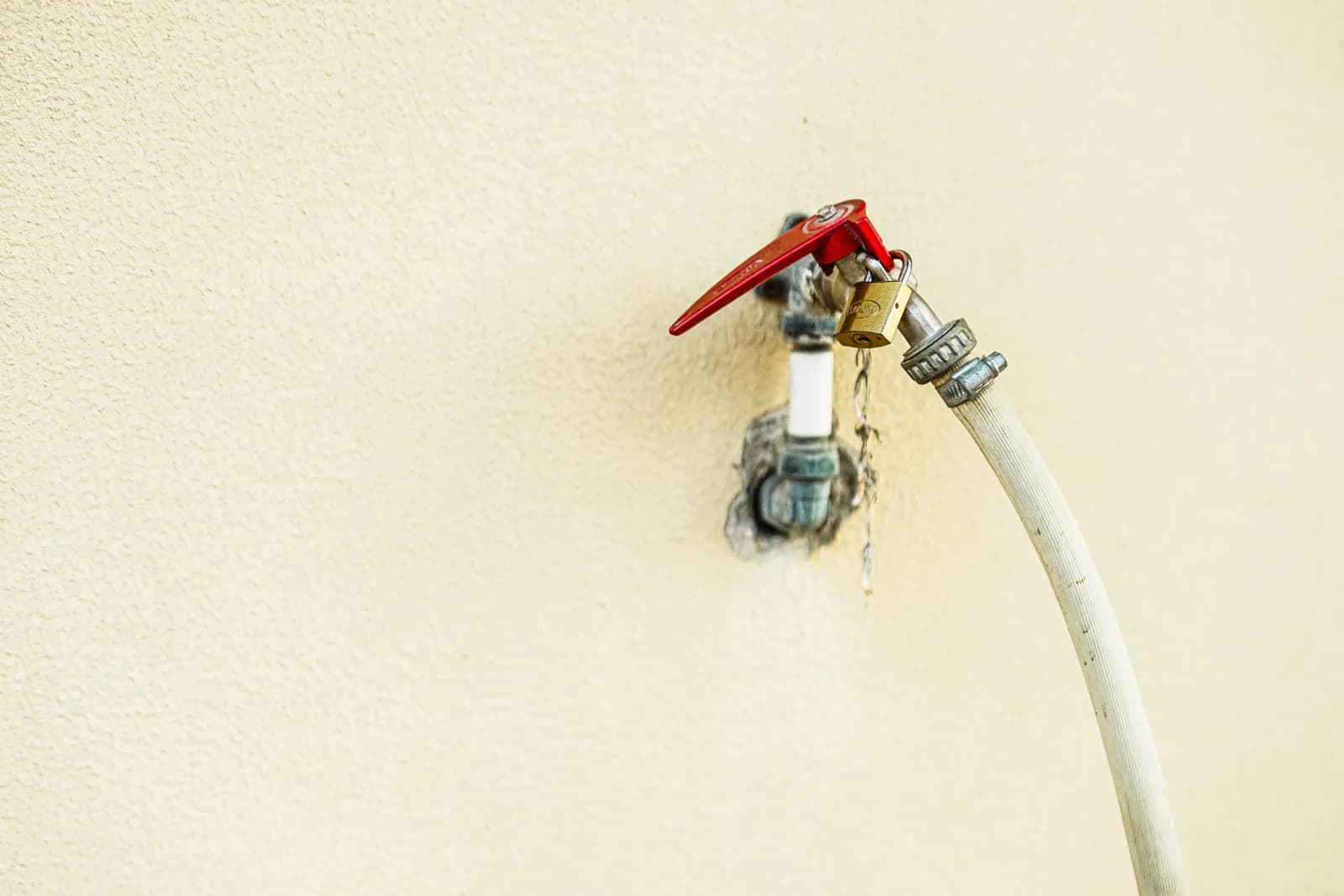
Every northern plumbing calendar tells you to blow out the sprinklers in October. In Baldwin County almost nobody does, and the state's own water accounting shows why: irrigation withdrawal here never falls to zero in any month of the year. December runs 34.4 million gallons a day, January 23.7, against a peak of 89.3 in August. The systems stay charged straight through the freeze window — which means the advice that matters is not about the buried lines at all.
It is about four exposed components, and each one fails differently.
Why doesn't the "winterize your sprinklers" advice work here?
Because the assumptions underneath it are northern assumptions: a hard-frozen soil column, a long continuous freeze, and a lawn that is unambiguously finished until spring.
None of the three holds in Robertsdale. Soil this far south does not freeze to any depth. The cold arrives as a handful of nights rather than a season — at the Robertsdale coordinate in calendar year 2025, 17 days fell to or below 32°F, nine to or below 28°F, two to or below 20°F, and the coldest reading was 12.2°F. And Alabama Extension's south Alabama lawn calendar for St. Augustine, zoysia and bermuda runs from February all the way through December.
So the buried laterals, sitting below a soil surface that never freezes hard, are broadly fine. The parts standing in open air are not.
There is a reason this county is wall-to-wall irrigated turf, incidentally, and it is a genuinely striking one. Baldwin County alone accounts for 26% of all irrigation water withdrawn in the state of Alabama — 58.42 million gallons a day, 81% of it pulled from groundwater. Fifteen percent of all statewide groundwater use happens in this county. The 2022 Census of Agriculture puts 853 farms and 180,784 acres here, ranking Baldwin first in Alabama for crop sales and second for nursery, greenhouse, floriculture and sod, with 10,513 acres in sod alone — around 43% of the state's nursery and sod acreage. The subdivisions going up along the Highway 90 corridor and out past Rosinton are built on ground that grew that sod, and they are irrigated accordingly.
The four components that actually break
The hose bib
Highest return on the least effort, and the one people skip. IBHS's winter guidance for warmer climates tells homeowners to pay close attention to crawl spaces and exterior hose spigots for exactly this reason.
A frost-proof hose bib is not a magic device. It works by putting the valve seat eight or ten inches back inside the heated wall, so when you close the handle the exposed barrel drains itself out the spout. Leave a garden hose attached and the barrel cannot drain — water stands in it, freezes, and splits the tube. Because the split is often inside the wall, you find out in April when somebody turns the spigot on and water comes through the ceiling of the room below.
Disconnect the hoses in November. Store them. That is the whole job.
The irrigation backflow assembly
This is the one that produces the expensive spring surprises. A backflow preventer on an irrigation line sits above grade by design, because it has to be accessible and testable, which means it is a brass body full of standing water sitting in open air on a 20°F night. Brass splits.
Insulating that assembly properly — a purpose-made cover, or wrapping plus a bag, with the drain path still clear — costs very little and it is the single most-skipped item on the list. The exposed riser feeding it deserves the same treatment.
Two honest limits here. Certified annual backflow testing requires a certification we do not hold, and you will want a certified tester for it. And we were not able to source a published cross-connection or testing program page for the local utilities, so if somebody tells you the county or your utility requires an annual test at your address, verify that with the utility directly rather than taking it from an article — including this one. What is squarely ours is freeze protection of the exposed assembly and repair of burst above-ground irrigation piping on the house side of the meter.
The well house
About 28,802 Baldwin County residents — roughly 14% of the county — are self-supplied by private wells, and that share runs far higher across rural Baldwin than it does in town. A private well means a pump, a pressure switch and a pressure tank, and in most cases they live in a small unheated shed or under a plywood cover in the yard.
That is a plumbing assembly with standing water in it, in outdoor air, on the coldest night of the year, twenty-five miles from the moderating effect of the Gulf. It is a predictable failure and it is worth a work light and a look in October.
We do not install or repair wells or well pumps — that is a licensed well and pump contractor's work, and it is not a call I am going to take and then hand back to you. Everything downstream of the pressure tank is ours: the line to the house, the fixtures, the filters and the water heater.
The exposed run under the house
Older stock across rural Baldwin sits on piers or has crawlspace sections, and supply line strapped to floor joists under an unskirted house is functionally outdoor plumbing. If the skirting has gaps, if a vent cover is missing, if a section of pipe hangs below the joists — those are the runs that fail. A drop in pressure that shows up only in cold weather is often the first hint.
Turning the system down without turning it off wrong
Warm-season turf here goes dormant from roughly late November through February, and Auburn's turf specialists note that dormant warm-season grass can survive up to 90 days without irrigation. Alabama Extension's guidance for this region is to water 4 to 6 inches deep, in the early morning, when the lawn actually needs it — which through a dormant winter is rarely.
So: shut it down at the controller for the dormant stretch. That is different from draining the system, and different again from a northern blow-out. It stops the system cycling on a schedule during a freeze week, which is when a scheduled 4 a.m. zone start on a 22°F morning does real damage to an assembly that was already borderline.
Then protect the exposed brass and leave the buried lines alone.
What to do if something has already split
The tell in spring is usually one of three things: a spigot that runs behind the wall when you open it, a wet patch of lawn that never dries, or a water bill that jumped with no change in habits. All three are leak detection work, and the second one in particular is worth chasing rather than living with — an irrigation-side leak downstream of the meter is billed to you at potable rates all summer.
A split spigot is straightforward faucet and fixture repair. A burst supply run under a house or a broken line between the meter and the building is water line repair. If it is running right now, shut the main and call — we answer around the clock at (251) 423-7654 for emergency plumbing. Brandon Byrd, Alabama Master Plumber MP-4462.
Where the cold nights actually land in this county is mapped in inland Baldwin County is colder than the beach, and why houses here fail nearer 20°F than 32°F is in the burst threshold piece. The rest of the season checklist is on the freeze prep page.
Sources. Monthly Baldwin County irrigation withdrawal, county share of statewide irrigation and groundwater use: ADECA Office of Water Resources, "Estimated 2015 Water Use and Surface Water Availability in Alabama" (Tables 27 and 32). Farm counts, acreage, crop-sales and nursery/sod rankings: USDA 2022 Census of Agriculture, Baldwin County profile. Private-well population: ADECA, Table 27. Insurance Institute for Business and Home Safety winter-weather guidance on crawl spaces and exterior hose spigots. Alabama Cooperative Extension south Alabama lawn calendar for St. Augustine, zoysia and bermuda; Auburn University turf guidance on dormant warm-season grass. Robertsdale freeze-day counts and minimum temperature: per-coordinate ERA5-Land daily reanalysis via the Open-Meteo archive, calendar year 2025 — a single year of measurement, not a climate normal. No published local cross-connection or backflow-testing program page was located for the utilities serving this area; verify any local requirement with your utility.