
Storm Surge and Sewer Backflow: Why Coastal Baldwin Houses Take Water From the Inside
Ground elevation, base flood elevation and one cleanout cap decide whether surge pushes the sewer backward into your house. The Baldwin County numbers.
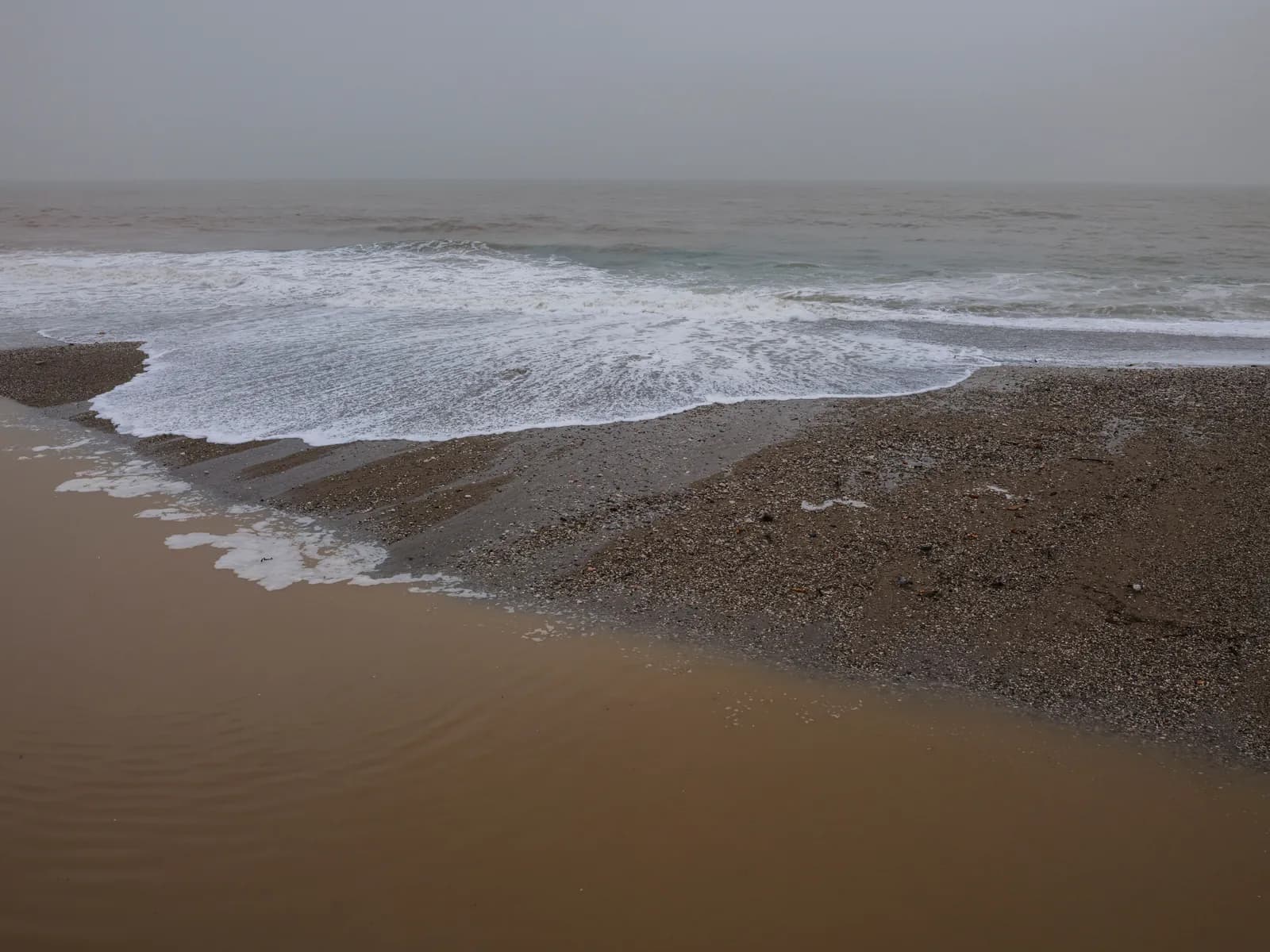
Hurricane Nate came through on October 7 and 8, 2017 and put 3 to 6 feet of storm surge inundation across coastal Baldwin County, worst along the immediate eastern shore of Mobile Bay. It damaged just under 200 piers. Three years later, Zeta crossed on October 28 and 29, 2020, and the National Weather Service surveyed peak inundation of 7 to 9 feet in northeast Mobile Bay, running along the Highway 90 causeway south to the immediate shores of Fairhope. Surge went across County Road 1 at Point Clear and damaged the Fairhope Pier seawall.
Both were October storms. Hurricane season runs to November 30, and the plumbing failure it causes is the one nobody sees coming, because it happens in a house whose roof never leaked.
Two numbers decide how exposed your address is
Ground elevation and base flood elevation. Here is what the ground does across this county, measured by USGS point queries at each town centre. Fort Morgan sits at 2.9 feet — the lowest ground elevation of the 22 communities Streamlined Plumbing serves. Gulf Shores, 7.2. Orange Beach, 11.2. Bon Secour, 20.9. Spanish Fort, 24.5. Then it climbs fast going inland — Loxley 167.9, Stapleton 224.6, Bay Minette 271.
Now the other number. FEMA's flood maps in the immediate area of those same coordinates carry mapped base flood elevations of 8 to 18 feet around Fort Morgan, 9 to 18 around Gulf Shores, 8 to 17 around Orange Beach and 9 to 14 around Fairhope.
Put those side by side and the plumbing problem writes itself. Out on the Fort Morgan Peninsula the ground at the coordinate is under three feet and the mapped design flood surface nearby runs to 18 — on the order of fifteen feet of water standing above the grade that a sewer cleanout cap, a grinder pump basin lid and a crawlspace vent are all set in. At Gulf Shores the same subtraction gives about eleven. Neither figure is a forecast; it is the surface the maps say to build to.
Two honesty notes, because these get misused. The elevation is a single point at the town centre, not an average, and the flood figures come from a query box around each coordinate rather than a municipal boundary — they describe what is mapped nearby, not what share of a town floods.
Velocity zones versus riverine zones — a real difference
FEMA's VE designation covers coastal areas with a 1% or greater annual chance of flooding plus an additional hazard associated with storm waves. FEMA's own framing of what a 1% annual chance means over time: a 26% chance of flooding over the life of a 30-year mortgage.
Fort Morgan is one of only 10 of the 22 communities Streamlined Plumbing serves with FEMA VE coastal velocity zones (wave action, not just still-water flooding). The others are Gulf Shores, Orange Beach, Bon Secour, Lillian, Point Clear, Montrose, Daphne, Fairhope and Spanish Fort. Bay Minette, Loxley, Stapleton, Robertsdale, Silverhill, Summerdale, Foley, Elberta, Magnolia Springs and Stockton carry AE riverine flooding on creeks and rivers instead.
The query box around the Fort Morgan coordinate shows how tightly those categories sit together out there: 40 mapped polygons, 8 of them VE, 7 AE and 25 Zone X. On a barrier strip that narrow, wave zone, still-water zone and minimal hazard are all within a couple of miles of each other. Gulf Shores returns 84 on the same query, 11 VE and 6 AE against 67 X.
The plumbing read on that split is mine, not FEMA's: still water fills a drain line through whatever opening it finds, while wave action also breaks things — a cleanout cap, a basin lid, a vent riser — and an opened line takes sand as well as water.
That matters more than it sounds. Fairhope's point query at the town centre returns Zone X, minimal hazard, at 120.9 feet. The same area query returns 128 AE polygons and 4 VE with base flood elevations from 9 to 14 feet. A town can be high and still have a bluff-bottom and a shoreline strip that are neither. Your town's zone is not your address's zone.
How does sewage actually move backward?
A drain system runs on gravity and air. Fixtures fall to a lateral, the lateral falls to the main sewer line, and a vent stack lets air follow the water so it can move at all. The design assumes the main is lower than the house and stays that way.
Surge breaks that assumption. When the main downstream is submerged or surcharged, the water in it goes to the next available opening — on most single-story coastal houses, a ground-floor shower pan or a laundry-room floor drain.
Rain compounds it from the other end. Sally dropped 29.99 inches at Orange Beach while 7 to 9 feet of peak inundation stood in southeast Baldwin's back bays. When the receiving water is that far above normal and rain is still falling behind it, the system is loaded from both ends at once. That is what a slow-moving Gulf storm does by design.
The storm does not even have to be aimed at us. Michael came ashore at Mexico Beach, Florida on October 10, 2018, better than 200 miles east, and NWS Mobile still logged 2 to 2.5 feet of surge on this stretch of the Gulf Coast and 0.22 inches of rain at Gulf Shores. Two feet of tide with no rain behind it won't flood a house — but it lifts the water a drain system discharges into, and that alone is enough to make the lowest opening the one that matters.
For pressure-sewer addresses the utility has stated where the boundary sits. Baldwin County Sewer Service's guidance is that if a lift station loses power and the properties on it keep using water, wastewater should not back up into the home — and that "if it does, there could be other issues, and we suggest that you consult with a plumber." A backup during an outage is usually a signal about your line, not just about the grid.
If it has already reached the floor, stop running water — multiple drains backing up at once is the one symptom where every extra gallon makes it worse. If it's only gurgling so far, you have time.
The cleanout cap tells you whose problem it is
The most useful thirty seconds of diagnosis available to a homeowner comes straight out of the county utility's own guidance: consider a clog in the plumbing line from the building to the sewer service line, especially if the outside sewer cleanout is not full of wastewater.
Read it as a fork.
Cleanout standing full, drains backing up inside. The blockage is downstream of that cap — on a sewered address, the service line or the utility; on a septic address, the tank, which gets checked first, not pumped.
Cleanout dry, drains backing up inside. The blockage is between the house and that cap. That is your line, and it is our work: camera the line, find the actual defect, then clear it. Sewer line repair and camera inspection or drain cleaning and hydro jetting depending on what the camera shows, and you can see what a sewer repair typically runs before we come out.
Low-lying addresses out on the Fort Morgan peninsula and along the bluff edge in Fairhope see this pattern most often.
Backwater valves: what the model code actually says
A backwater valve is a one-way flap in the drain line that closes when flow tries to come back toward the house. Useful device, frequently installed wrong.
The International Plumbing Code, section 715.1, does two things. Fixtures on a floor below the elevation of the next upstream manhole cover "shall be protected by a backwater valve." And fixtures above that elevation "shall not discharge through a backwater valve."
The second half is the part that gets ignored. Put the whole house behind one valve and when the flap closes, everything upstairs has nowhere to discharge either. The code separates them on purpose.
On the local requirement I'd rather be straight than guess. Baldwin County adopted the 2024 IPC with amendments by Commission Resolution #2025-067 on March 5, 2025, and I have not read the amendment text, so I don't know whether it modifies section 715. Treat the model code as model code and confirm your address with the Baldwin County Building Department before anyone installs one.
It also needs an accessible cover and periodic cleaning. Buried and forgotten it fails — stuck open, protecting nothing, or stuck closed, so your own house can't drain. If you can't say when yours was last opened, handle it before December.
On scope: certified annual backflow-preventer testing on a potable, irrigation or fire line is a separate certification and we don't offer it — you'll want a certified tester. Sewer backflow during a surge is drain and sewer work, which is a different job.
What to actually do between now and November 30
Find your cleanout and photograph it. Clear a two-foot radius around the cap so somebody can get a camera in it at 11 p.m. in the rain. If the cap is cracked or missing, replace it — a broken cap lets stormwater into the line, which is the opposite of what you want going into a surge event.
Distance is the argument for doing it now. The drive from the Fairhope shop to the Fort Morgan coordinate is 51.6 miles and about 81 minutes — the highest drive time from the Fairhope shop of the 22 communities Streamlined Plumbing serves. That changes nothing about the plumbing and everything about what a phone call is worth: full cleanout or dry cleanout is a question whoever is standing on the peninsula can answer in thirty seconds.
If you're on a grinder pump, know where the breaker is and confirm the basin lid is seated. And a house that has backed up before is the best predictor that it will again — worth a camera run in September rather than a phone call in October.
We answer around the clock — (251) 423-7654. Brandon Byrd, Alabama Master Plumber MP-4462.
The pre-storm sequence is the plumbing shutdown order before you evacuate; what to check on return is coming back to a house that sat through a storm.
Sources. NWS Mobile event pages for Hurricanes Nate, Zeta, Sally and Michael (weather.gov/mob). FEMA glossary, Zone VE and V1-30. FEMA National Flood Hazard Layer point and envelope queries at each town coordinate, fetched 2026-08-01. USGS 3DEP elevation point queries (epqs.nationalmap.gov). Drive time by OSRM road routing from 59 Morphy Ave, Fairhope. Baldwin County Sewer Service severe-weather guidance and grinder pump FAQs. IPC section 715.1 (model code). Baldwin County Commission Resolution #2025-067, adopted March 5, 2025.