
Before You Evacuate: The Plumbing Shutdown Order for a Baldwin County House
A storm-order checklist for shutting a Baldwin County house down — the main valve test, the grinder pump breaker, and the two systems we can't fix for you.
Hurricane season runs June 1 through November 30, and the climatological peak is September 10. The National Hurricane Center's own progress-of-the-season table puts named storms four through eleven between roughly August 15 and October 2 — meaning a large share of a normal season lands inside a seven-week stretch that is starting right now.
Most storm checklists cover water, batteries, fuel and boards. Almost none cover the plumbing, and on the Eastern Shore and down at the beach the plumbing decides whether you walk back into a house you can live in.
This is the order I'd work in. Some of it should already be done; some takes ten minutes on the way out.
The main valve test is a July job, not a landfall-day job
Ready.gov's guidance on this is worth reading word for word, because it assumes something most homeowners haven't checked:
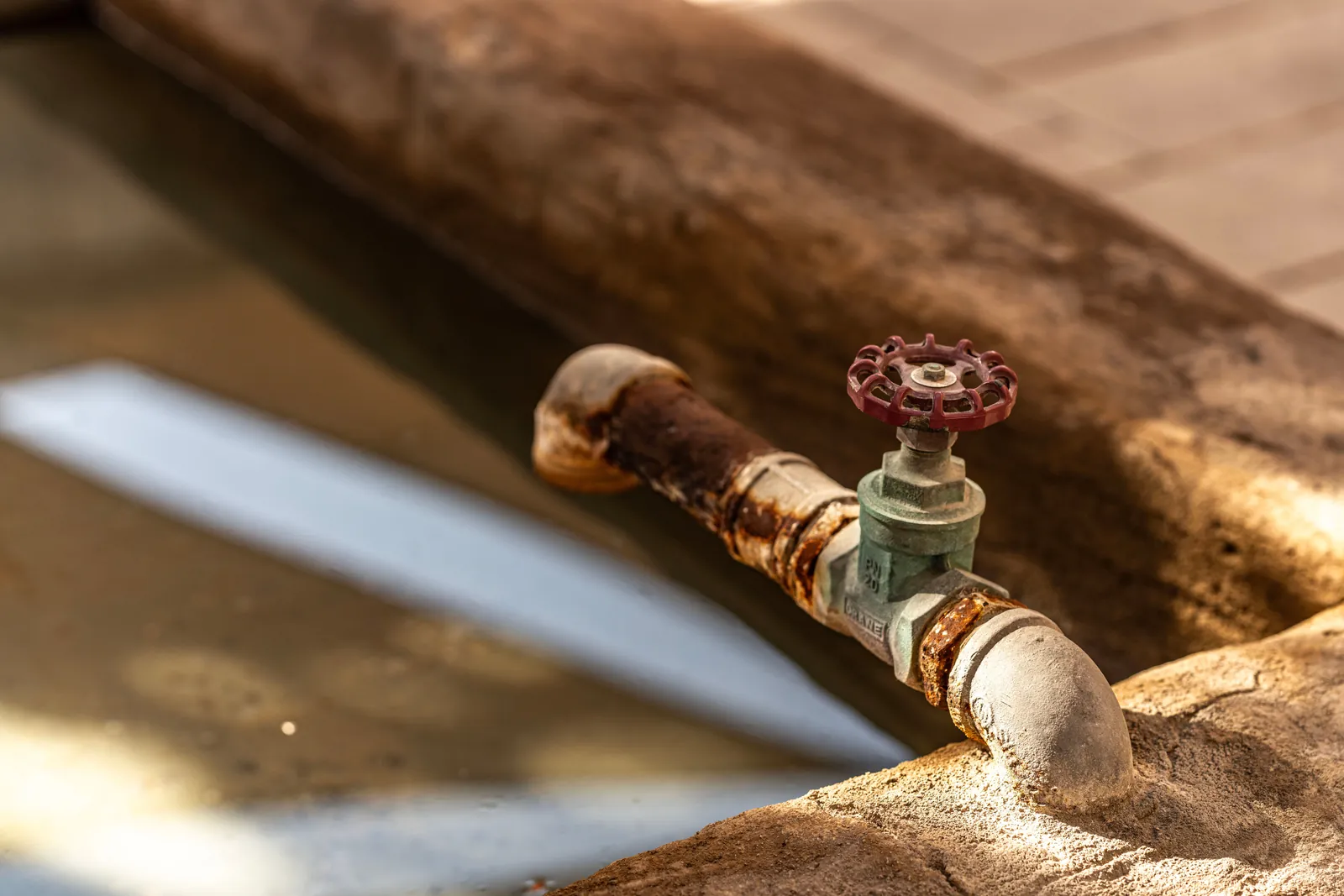
"Find the shut-off valve for the main water line that enters your house and tag it for easy identification. Make sure everyone in your household knows where it is… Your valve may be rusted open or it may not close all the way. If so replace it."
That last sentence is the whole point. A main shutoff valve that has sat untouched for fifteen years in coastal humidity frequently will not close. You find that out by trying it on a calm afternoon, not by trying it while the outer bands are coming in. If it turns but doesn't stop the flow, that's water line repair work and it's a short visit.
Ready.gov also flags which valve you don't want: "This is not the street valve in the cement box at the curb — the street valve is extremely difficult to turn and requires a special tool."
And one benefit nobody expects. Shutting the main doesn't empty your system — it holds it. In Ready.gov's words, "the effects of gravity may drain the water in your hot water heater and toilet tanks unless you trap it in your house by shutting off the main house valve." A 50-gallon tank you've trapped is 50 gallons of clean water sitting in your house when you come home.
If your sewer is a grinder pump, one breaker decides how the week goes
Much of the low ground in this county doesn't drain to a gravity sewer. It drains to a grinder pump — a basin buried in the yard with a lid at grade and a control panel on a wall. Gulf Shores sits at about 7 feet of ground elevation at its town centre. Fort Morgan is under 3. Orange Beach is around 11. There isn't enough fall for gravity to do the work, so a pump does it.
Baldwin County Sewer Service publishes one line about evacuation, and it's not ambiguous:
"If evacuating, turn off your grinder pump breaker before evacuating."
Here's the mechanism behind it. BCSS states that "a standard pump basin holds approximately 100 gallons of wastewater, depending on what type you have, and you can remove the pump's lid when the power goes out to see the level in your basin." When power is out and water keeps going down the drains, that basin fills and then, in their words, overflows "from the vent on top of the lid." A hundred gallons is not a lot of household use — two people, one evening.
The other half of that instruction is who is responsible for what. BCSS says plainly that it "is not responsible for pump systems and sewer service lines on private property," and that it does not service pumps without power. Their guidance on a backup during an outage ends: "there could be other issues, and we suggest that you consult with a plumber." That's where our work starts and theirs stops — grinder pump service and replacement on the private side.
If you're staying rather than leaving, the generator spec matters and it's higher than people assume. BCSS: "The 240 Volt generator must be rated at 6500watt continuous / 8125 watt starting minimum." An undersized generator won't start the pump — it'll just brown out trying. BCSS also makes a transfer switch available to existing grinder-pump customers, and pumps they installed from 2021 onward already have one fitted. Ask BCSS what that costs today; a price for somebody else's product has no business being quoted in an article.
Why does this matter more than a checklist item? The power outage is the long part. Hurricane Ivan made landfall just west of Gulf Shores at 1:50 a.m. on September 16, 2004, as a Category 3 with 120 mph sustained winds, and the National Weather Service in Mobile records that the damage across Baldwin County exceeded both Frederic in September 1979 and Opal in October 1995. Published assessments of Ivan put the average outage for Orange Beach residents at 12 days.
Twelve days, not landfall night, is the number to hold. A hundred-gallon basin and a household that keeps flushing is a problem measured in hours; twelve days without power is a different order of question, and the breaker is the only free answer to it. Coastal addresses in Gulf Shores and Orange Beach run into this every season.
Does any of this apply if you're not at the beach?
The Eastern Shore is the case people get wrong. A bluff address reads as safe because the bluff is high, then the water arrives from a direction nobody planned for. When Katrina came ashore to the west on August 29, 2005, the National Weather Service estimated storm tides of 9 to 11 feet in Baldwin County, and FEMA high-water marks north of Fairhope came in over 13 feet. Mobile Bay is shallow and runs north–south, and a storm passing west of it drives wind up its length — which is what that high-water mark records.
A bay-side house gets the same shutdown sequence a Gulf Coast house gets. The only thing that changes is the second step: whether there's a pump breaker to flip on the way out, or enough fall that gravity does the work unaided.
Septic tanks and private wells: what to do, and who to call
Both are common here and neither is ours to fix. I'd rather say so plainly than take a call I can't finish.
Septic. The CDC's pre-storm guidance for onsite systems is to be sure your septic tank is at least half full, to keep it from collapsing or floating when the ground around it saturates, and to turn off any effluent pump at the circuit box before the area floods. We do not pump septic tanks — that's a licensed septic contractor's work. What is ours is the drain line running from the house out to the tank: a different pipe, a different problem, and the one that actually clogs.
Wells. The Alabama Department of Public Health reports that roughly 800,000 people — about 20 percent of the state — depend on private supplies like wells for drinking water, and whole communities in this county are on them. We do not install or repair wells or well pumps. To get water tested, ADPH's route is to call your county health department and ask that an environmentalist collect a sample. Ours is everything downstream of the pressure tank: interior lines, fixtures, aerators, filters and the water heater.
The ten-minute walk-through on the way out
- Shut the main, on the house side, all the way.
- Turn the grinder pump breaker off if you have one.
- Close the angle stops behind the washing machine, dishwasher and refrigerator. Braided supply lines are the most common thing to fail in an empty house, and they fail wide open. We install and reconnect appliance connections and shutoffs, though not the appliances themselves.
- If you have a sump pump, check the float moves freely and the discharge line isn't blocked. A sump pump service call in August is cheap; a flooded floor in September isn't.
- Leave the water heater alone. Don't drain it. You just trapped it.
If the house isn't yours to be standing in
Second homes and vacation rentals aren't a niche here, they're the stock. The census counts 14,668 total housing units in Gulf Shores against 7,262 occupied by a year-round household — so on any given evacuation, something close to half the doors on a street have nobody behind them. The person who needs to flip that grinder pump breaker is often a manager, a cleaner, or a neighbour with a key.
Write the sequence down and leave it where they'll find it: where the main valve is, where the pump breaker is, and a phone number for someone who can be called. If you manage more than one property, we do this work on the vacation rental and turnover side too.
If the property is a condominium, most of the list above isn't yours. OpenStreetMap maps 218 apartment and condominium buildings within about five kilometres of the Gulf Shores town centre — the highest mapped apartment/condo buildings of the 22 communities Streamlined Plumbing serves — so a large share of the units emptying out along Beach Boulevard have no house main valve, no yard basin and no breaker of their own. What a unit owner has is a branch shutoff inside the unit; the building owns the rest. Where the shutoffs actually are in a coastal condo covers that layout, and it's a genuinely different ten minutes.
When to call
Before the storm, not after, if the answer to any of these is no: does the main valve close completely, do you know where the grinder pump breaker is, has the pump been serviced in the last year. Short scheduled visits in early September; all-day problems in late September.
After the storm, if drains are slow, the yard smells, or the basin lid is wet — that's emergency plumbing work and we answer around the clock. Streamlined Plumbing, (251) 423-7654. Brandon Byrd, Alabama Master Plumber MP-4462.
Coming back is a different set of decisions — that's what to check before you use the water in a house that sat empty through a storm. The geometry of why surge pushes sewage backward is in storm surge and sewer backflow on the Baldwin County coast.
Sources. National Hurricane Center season climatology (nhc.noaa.gov/climo). Ready.gov, "Safety Skills," last updated 03/20/2026. Baldwin County Sewer Service, severe-weather guidance and grinder pump FAQs (baldwincountysewer.com). NWS Mobile event pages for Hurricane Ivan and Hurricane Katrina (weather.gov/mob); the 12-day Orange Beach outage figure comes from the post-storm Ivan assessment record. CDC, guidelines for septic and onsite wastewater systems. Alabama Department of Public Health, well water program. Ground elevations from USGS 3DEP point queries at each town centre. Housing-unit and occupancy counts from Census ACS 2023 5-year estimates at place level. Building counts from OpenStreetMap via Overpass, within about five kilometres of the town coordinate — not municipal boundaries.