
Is Drain Opener Bad for Pipes? Read the Label's Own Conditions First
Caustic openers are sold for slow drains, not stopped ones, and not for toilets. Out past Rosinton, where ten of our 22 communities are on private septic, there is a second reason to leave the bottle alone.
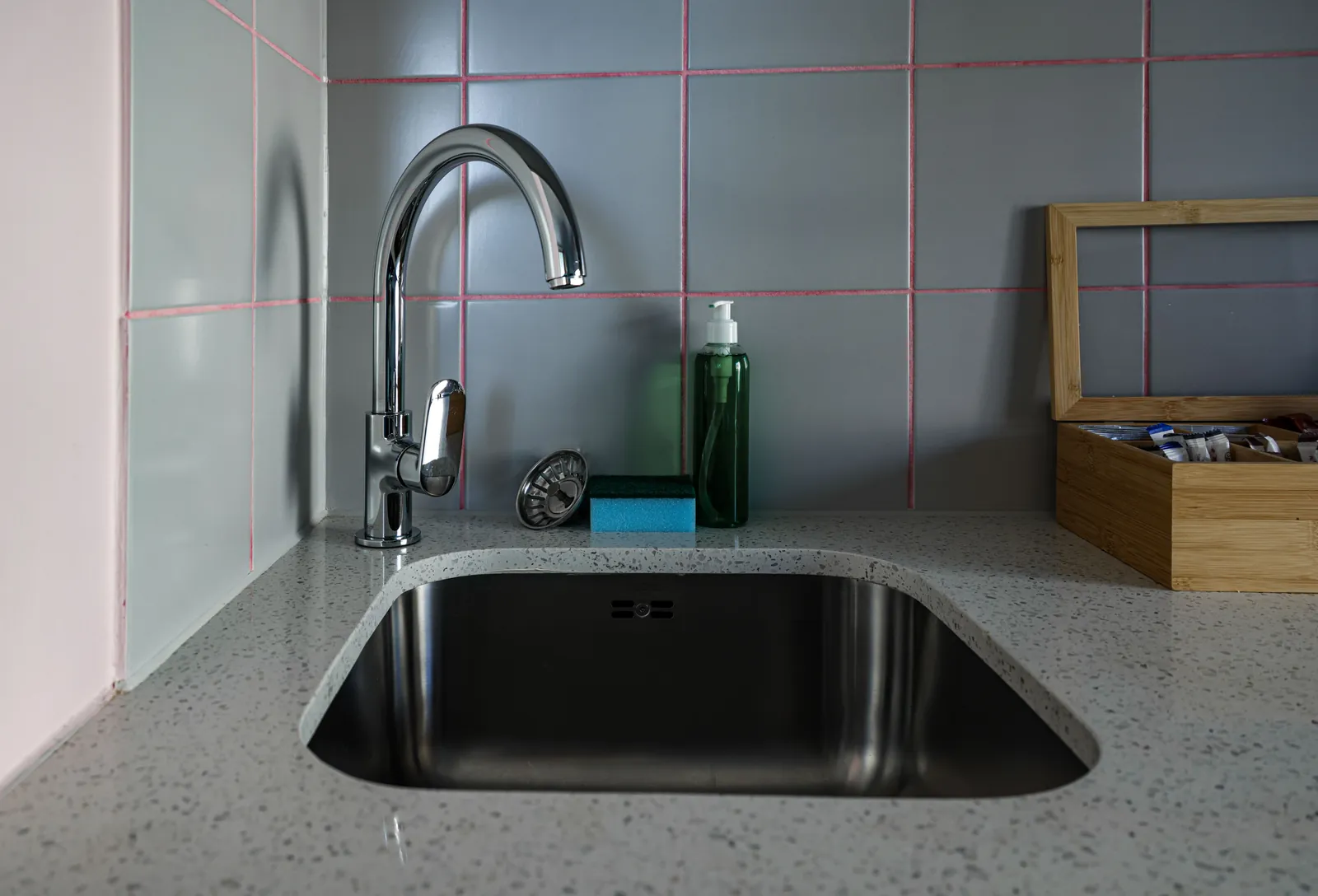
The honest answer to whether drain opener damages pipes is that the product's own label already tells you the conditions under which it is safe — and the situation almost everyone is in when they buy it is not one of them. Caustic openers are formulated for a slow drain: enough flow remains to carry the chemical through, do its work, and flush away. On a fully stopped line there is nowhere for it to go, so it pools above the blockage and stays in contact with the pipe for hours. That is the whole difference.
Here is what is actually happening in there, and what to do instead.
What the chemistry is doing
The active ingredient in the common household products is sodium hydroxide — caustic soda — which breaks down fats, hair and other organics. That reaction gives off heat, and several gel formulations add aluminium particles specifically to increase it, because a warm reaction works faster than a cold one.
Two things follow. First, heat inside a sealed trap is not free of consequences: PVC and ABS drainage are not damaged by alkali but they do have a temperature they are happy at. Second, and more importantly, none of that chemistry distinguishes between the clog and the pipe. It reacts with what it touches for as long as it touches it. On a slow line that contact lasts minutes. On a stopped one it lasts until somebody clears the blockage — which, if the bottle failed, is whenever the plumber arrives.
The risk that has nothing to do with plumbing
This part gets left out of every plumbing article and it should not be.
In the 2023 Annual Report of the National Poison Data System, America's Poison Centers recorded household cleaning substances as the single most frequent exposure category among children aged five and under — 10.1% of all such cases — and the second most frequent substance class across all human exposures at 7.12%. A bottle of caustic soda under a kitchen sink is one of the more dangerous objects in an ordinary house, and it is generally stored at the height of a toddler's shoulder.
The second exposure risk is the one we care about professionally. When a line that has been dosed is finally opened, the pooled liquid moves — into the trap, back up the fixture, or toward whoever is working on it. That is why the first question on a drain call is what has already gone down there. It is not an interrogation; it changes the eye protection and the containment we bring to the work.
Why does this land differently out in rural Baldwin County?
Because of what the line drains into.
Ten of the 22 communities Streamlined Plumbing covers have no active community water system registered with EPA: Bon Secour, Fort Morgan, Lillian, Magnolia Springs, Montrose, Perdido, Point Clear, Rosinton, Stapleton and Stockton. An address with no utility water is very often an address with no utility sewer, which means a private septic system in the yard.
A septic tank is not a container that waits to be emptied. It works because a bacterial population digests solids continuously, and the drain field beyond it depends on that digestion having happened. Caustic and bleach-based products are designed to destroy organic matter — they do not stop being good at that when they reach the tank. One bottle will not sterilise a septic system. A bottle a month, poured into the same kitchen line for a couple of years, is a genuine risk to the most expensive component on the property.
I will state the scope plainly, because it saves people money: we do not pump septic tanks and we do not service septic systems. That is a septic contractor's trade. What we can tell you is something worth knowing before you pay anyone — a recurring backup on a septic property is frequently a full tank rather than a blocked line, and snaking a line that was never obstructed fixes nothing.
What the pipe under your house is made of
The other variable is age, and this county spans a wide range of it. Robertsdale carries a median year built of 2001 and is served by two registered systems — the City of Robertsdale serving 13,242, and East Central Baldwin County Water and Fire Protection Authority serving 5,496. Head out along Hwy 90 through the Highway 90 corridor toward Rosinton, past Elsanor, and up into rural Baldwin County, and you find a much older mix.
The medians tell the story: Bay Minette at 1976, Perdido at 1979, Magnolia Springs at 1983. Housing of that vintage frequently still has cast iron drainage, and cast iron is already corroding from the inside as a matter of course. That process has its own stages and its own timeline, set out in how cast iron drain pipe fails; the relevant point here is only that a pipe already losing wall thickness is a poor candidate for repeated chemical exposure, and that a rough, narrowed bore is exactly the condition in which a caustic product fails to clear the blockage and therefore stays put.
The ladder to work through instead
Nothing on this list is expensive and all of it is more likely to work.
Clean the P-trap. A bucket, a pair of slip-joint pliers and ten minutes. On a lavatory this is where hair collects, and pulling the pop-up stopper often solves the problem on its own.
Very hot tap water and dish detergent, on a kitchen line only. A surfactant and heat will move a soft grease film. Hot tap water, not boiling — and this is a maintenance measure for a slow drain, not a rescue for a stopped one.
A hand auger. A short cable reaches into a branch line past the trap and physically removes what is there. It is the right first tool, and it is genuinely something to own. Anything beyond a branch line wants a machine, which is drain cleaning work.
Enzyme maintenance products. Slow-acting, non-caustic, and a reasonable monthly habit on a kitchen line — including on septic. They are not an emergency product and anyone selling them as one is overpromising.
Then stop. If one drain stays slow after all of that, or if it gurgles, or if more than one fixture is affected at once, the problem is not at the trap. Two or more fixtures unhappy together points down the main line and the correct move is to stop running water rather than to try harder.
The tool that comes next — a cable machine or a jetter — depends entirely on whether you have a discrete obstruction or an accumulation along the run, and that comparison is set out in hydro jetting vs snaking. What the clearing side costs is published so you can read it before anybody is standing in your kitchen, and if what a camera finds is a defect rather than a blockage, that is sewer line repair rather than another cleaning.
If it is backing up into the house now, stop using water and call. We answer around the clock at (251) 423-7654 — emergency plumbing. Brandon Byrd, Alabama Master Plumber MP-4462.
Sources. Household cleaning substance exposure figures from the 2023 Annual Report of the National Poison Data System (NPDS), America's Poison Centers, 41st Annual Report — 10.1% of exposures among children aged five and under, 7.12% across all human exposures. Sodium hydroxide is the caustic active in common household drain openers; the exothermic reaction between sodium hydroxide and the aluminium particles used in some gel formulations is standard chemistry. Community water system names, populations served and system status from the EPA SDWIS drinking-water registry. Median year built from Census ACS 2023 5-year estimates at place level.